
Health Checkups in Korea in Your 30s and 40s: What Americans and Brits Are Booking (and Why)
A practical guide to full-body health screening in Korea—including costs, what’s included, and women’s, heart, digestive, and brain health checkups for foreigners.


- 1. Why Americans and Brits Are Choosing Health Checkups in Korea
- 2. Four Korean Health Checkup Packages for Common Concerns in Your 30s and 40s
- 3. English Results and Follow-Up After Your Korean Health Checkup
- 4. How to Book a Health Checkup in Korea as a Foreigner
- 5. Korean Health Checkup FAQ
Health Checkups in Korea in Your 30s and 40s: What Americans and Brits Are Booking (and Why)
Hi—I’m Millie, a Creatrip editor.
I’m Korean American and have been through the Korean health checkup process myself, so I tend to look at these things the same way I would if I were booking for myself: What am I actually getting, and is it worth it?
After the recent BBC story on people traveling to Korea for health screenings, we started getting a noticeable wave of similar questions through Creatrip.
Most came from Americans and Brits in their 30s and 40s asking the same things: What should I get checked at this age, and which package makes the most sense for me?
So I put together this guide around the four health concerns we hear about most often from that group
1. Why Americans and Brits Are Choosing Health Checkups in Korea
Most of the conversations I have with people considering a checkup in Korea eventually come back to the same three things.
1) Cost
The biggest difference is that you’re not paying for every test separately.
Here’s KMI’s Signature package, one of the more comprehensive options for people in their 30s and 40s, compared test by test with typical U.S. self-pay and UK private prices.
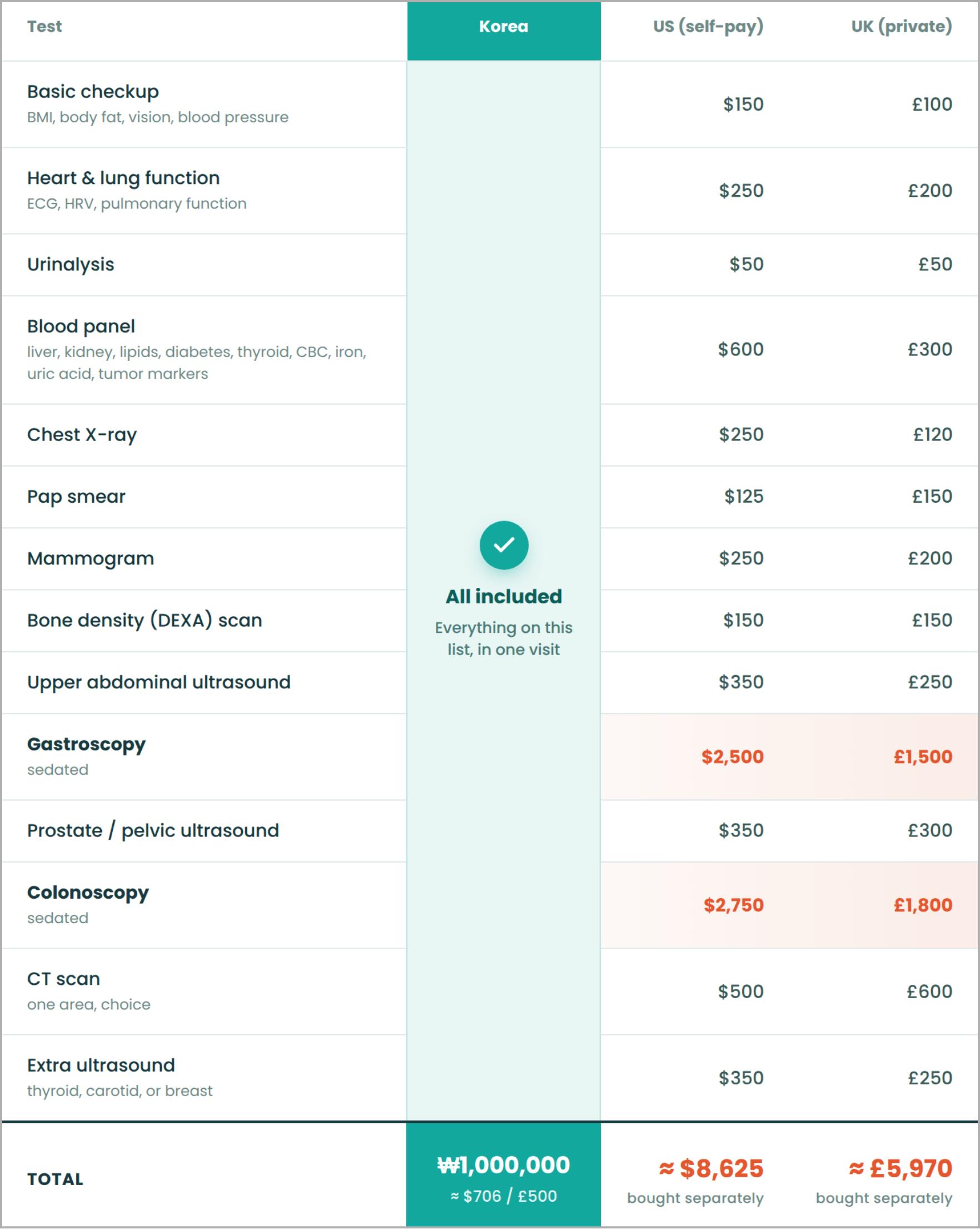
(U.S. figures are typical self-pay ranges for upper endoscopy, colonoscopy, and DEXA; UK figures are based on private scan and cancer screening guides. Individual prices vary by clinic and region.)
The entire Korean package can cost less than a single colonoscopy at a U.S. hospital, depending on where you go. That’s one of the biggest reasons Korea starts to look interesting once you compare the numbers side by side.
2) Booking and wait time
The second difference is how easy it is to actually get everything booked.
In the U.S. and UK, tests like MRI, ultrasound, or endoscopy can mean referrals, separate appointments, insurance questions, and a fair amount of waiting.
In Korea, the process is much more direct:
you choose a package and date, book it yourself, and complete the included tests in one visit.
If your package includes a colonoscopy, you’ll just need to plan ahead for the prep kit. Your English results report is then sent by email about 10 to 15 days later.
3) What a Korean full-body health screening includes
One of the biggest advantages of a Korean health checkup is how much you can get done in one place, in one visit. At KMI, bloodwork, ECG and lung testing, ultrasound, endoscopy, women’s screening, bone density testing, and imaging can all be completed at the same center, often within just a few hours.
With services like Ezra, Prenuvo, and Neko Health becoming more popular, you might wonder, Why get a health checkup in Korea if I can get one at home?
The overall goal is similar—finding potential health risks early—but Korean checkups are put together a little differently. Ezra and Prenuvo are largely imaging-led, while Neko focuses more on skin, cardiovascular, metabolic, and blood-based health signals.
A Korean comprehensive checkup looks at different parts of the body with different types of tests—endoscopy for the stomach and colon, ultrasound for abdominal organs, ECG for the heart, women’s screening, and targeted CT or MRI. The idea is to put all of those pieces together for a broader picture of your health.
2. Four Korean Health Checkup Packages for Common Concerns in Your 30s and 40s
So, based on what’s been on your mind lately, here’s which Korean health checkup might make the most sense for you.
1. Women’s Health Screening in Korea
If you’re a woman in your 30s or 40s, you probably already have a few different things you’re trying to stay on top of—Pap smears, breast screening, maybe thyroid or iron levels too. The tricky part is that checking several of those areas can quickly turn into different appointments, providers, and days off your calendar.
This package lets you cover a much wider range of women’s health screening in one visit, including breast, cervical, pelvic, thyroid, iron, and bone health.
Best for: Women who want a more complete picture of their health without booking every test separately.
Focus area | What it covers |
|---|---|
Breast | Mammogram + breast ultrasound |
Uterus & ovaries | Abdominal & pelvic ultrasound |
Cervix | Pap smear |
Thyroid | Thyroid ultrasound + Free T4 blood test |
Iron & bone | CBC, iron/anemia panel, bone density scan |
Plus a full base checkup: bloodwork, chest X-ray, ECG, gastroscopy and colonoscopy options, and more.
Cost: Roughly $706 / £500 · Time: about 3 hours
View the Women’s Health Screening package in Korea →
2. Heart Health Screening in Korea
If heart disease runs in your family, getting a normal cholesterol or blood pressure result can still leave you wondering, Is that enough to know what’s actually going on with my heart? Routine checkups in the U.S. and UK are largely focused on risk factors, while imaging that can look at your heart or coronary arteries is usually added more selectively.
This package goes a step further, combining the usual cardiovascular risk checks with imaging of your heart and coronary arteries.
Best for: Anyone with a family history of heart disease, or who wants to look beyond routine cholesterol and blood pressure results.
Focus area | What it covers |
|---|---|
Coronary arteries | Coronary calcium CT |
Heart structure & function | Echocardiogram |
Rhythm | ECG + heart rate variability |
Metabolic risk | Lipid panel + diabetes screening (glucose, HbA1c) |
Cardiac markers | Cardiac enzymes, hs-CRP |
Plus a full base checkup: endoscopy options, abdominal & pelvic ultrasound, bloodwork, and more.
Cost: Roughly $706 / £500 · Time: about 3 hours
View the Heart Health Screening package in Korea →
3. Digestive Health Screening in Korea
If you’re in your 30s or early 40s, a colonoscopy usually isn’t part of routine screening yet—and gastroscopy isn’t something most people get preventively either. If you want to have both checked privately or out of pocket, the cost can add up very quickly.
That’s where the price difference in Korea gets hard to ignore. For roughly $706 / £500, this package includes both a sedated gastroscopy and colonoscopy, along with an abdominal CT, ultrasound, digestive bloodwork, and the rest of the comprehensive checkup.
In other words, you’re getting both endoscopies plus a full health screening for a price that can be less than one private procedure back home.
Best for: Anyone who has been putting off a colonoscopy or gastroscopy because of the cost, or wants to check the stomach, colon, and other abdominal organs in one visit.
Focus area | What it covers |
|---|---|
Colon & rectum | Colonoscopy with sedation |
Stomach & esophagus | Gastroscopy with sedation |
Liver, gallbladder, pancreas | Upper abdominal ultrasound |
Abdominal organs | Abdominal CT |
Digestive bloodwork | Liver & pancreas function, hepatitis B screening |
Plus a full base checkup: thyroid tests, women’s & bone health, bloodwork, and more.
Cost: Roughly $706 / £500 · Time: about 3 to 4 hours
View the Digestive Health Screening package in Korea →
4. Brain Health, Stroke & Dementia Screening in Korea
If dementia or stroke runs in your family, one of the hardest parts can be figuring out what you can actually check before you have symptoms. Brain health is something a lot of people worry about, but brain imaging and dementia-focused testing aren’t usually part of a routine checkup in the U.S. or UK.
This package gives you a place to start, combining MRI or MRA with blood-based brain health markers, genetic risk testing, and vascular imaging.
Best for: People with a family history of dementia or stroke who want a closer look at their brain, vascular, and genetic risk factors.
Focus area | What it covers |
|---|---|
Brain structure & vessels | Brain MRI or MRA |
Cognitive risk markers | AlzOn brain health blood test |
Inherited risk | Dementia / cerebrovascular genetic test |
Vascular add-ons | Carotid ultrasound, echocardiogram, choice of CT |
Plus a full base checkup, tumor markers, thyroid panel, and more. This is the most comprehensive package, with 94 to 96 tests.
Cost: Roughly ₩2,150,000 (about $1,518 / £1,075) · Time: about 4 hours
View the Brain Health, Stroke & Dementia Screening package in Korea →
3. English Results and Follow-Up After Your Korean Health Checkup
About 10 to 15 days after your visit, you’ll receive a detailed health checkup report in English by email. Chinese and Japanese reports are also available.
Here’s what an actual English KMI health checkup report looks like:
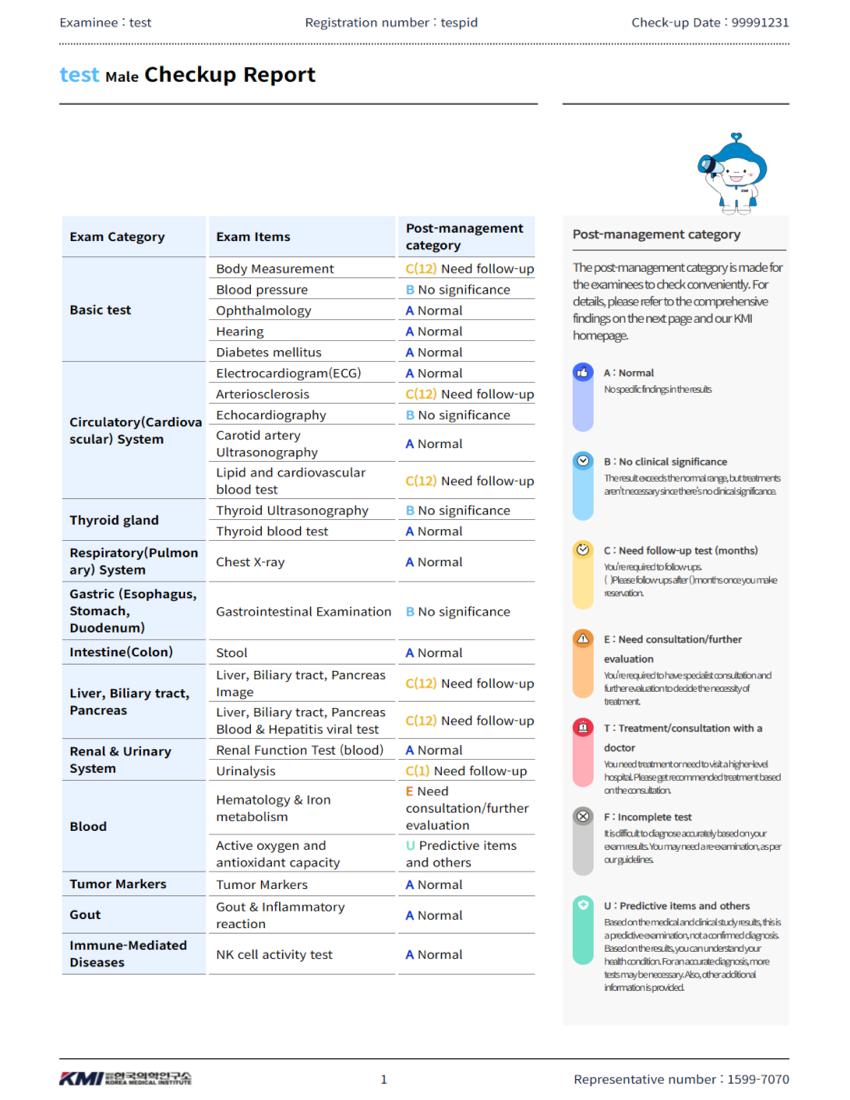
If further evaluation is needed, KMI’s referral service can connect patients with major Korean hospitals, including Samsung Medical Center, Asan Medical Center, Severance Hospital, Seoul National University Hospital, Chung-Ang University Hospital, and Catholic St. Mary’s Hospital.
4. How to Book a Health Checkup in Korea as a Foreigner
The actual booking process is pretty simple.
Step 1. Choose your health screening package and date
Pick the health concern that matters most to you and choose a date that works with your Korea itinerary.
Booking through Creatrip also includes:
- A complimentary CT or MRI add-on
- One-on-one Creatrip Buddy support via WhatsApp before, during, and after your visit
- Creatrip points you can use elsewhere on your trip
View KMI Health Checkup Packages in Korea →
Step 2. Fill out the booking form and pay the deposit
A KRW 20,000 deposit confirms your booking. It’s refunded after your checkup, and you’ll also receive 20,000 Creatrip points.
Step 3. Prepare for your health checkup
If your package includes a colonoscopy, book at least 7 days ahead if you need to pick up the prep kit at the center, or about 2 weeks ahead if you want courier delivery. Some women’s screening tests also have timing recommendations depending on your cycle.
We send a foreigner-focused preparation guide beforehand so you know what to expect.
Step 4. Complete your screening
Complete the tests, pay the remaining balance at the center, and then please go eat something good because you’ve probably been fasting since the night before.
5. Korean Health Checkup FAQ
How much does a full-body health checkup in Korea cost?
The packages in this guide start at around ₩1,000,000 (about $706 / £500) for a comprehensive screening. The most extensive brain, stroke, and dementia package is around ₩2,150,000 (about $1,518 / £1,075).
The exact cost depends on the package and tests you choose.
Can foreigners book a health checkup in Korea without a referral?
Yes. You can book these preventive health screenings directly without getting a referral from a doctor first.
What tests are included in a Korean full-body health checkup?
It depends on the package, but comprehensive Korean health screenings can include blood and urine tests, ECG, chest X-ray, ultrasound, mammogram, bone density testing, CT, gastroscopy, and colonoscopy.
More specialized packages can also include brain MRI or MRA, echocardiography, coronary calcium CT, genetic testing, and advanced blood markers.
How long does a health checkup in Korea take?
Most comprehensive health checkups take around three hours. Packages that include a colonoscopy, MRI, or more advanced testing can take closer to four hours.
Can I get a colonoscopy and gastroscopy (upper endoscopy) during the same health checkup?
Yes. Some Korean health screening packages include both gastroscopy and colonoscopy with sedation in the same visit.
You’ll need to prepare for the colonoscopy in advance, so make sure to arrange your prep kit before your screening date.
Will I get my Korean health checkup results in English?
Yes. KMI provides a detailed English results report by email, usually about 10 to 15 days after the health checkup.
You can take the report back to your doctor in the U.S., UK, or another country if anything needs further review.
How should I fit a health checkup into my Korea trip?
The checkup itself usually takes one morning, so I’d schedule it toward the beginning of your trip rather than squeezing it in before your flight home.
If you’re doing a colonoscopy, remember that you’ll need the prep medication beforehand, so build that into your itinerary too.
And if you get stuck trying to choose, my inbox is open: hyeeum.kim@creatrip.com.