Seoul Metro for Travelers: Fares, Lines, Transfers, and Smart Routes
A practical Creatrip read on using Seoul’s subway confidently, from T-money fares to Line 9 express trains and airport connections.

Seoul Metro is bigger than the word Metro suggests
In Seoul, the subway is not the backup plan. It is often the fastest, cleanest, and least dramatic way to move through the city, whether the day starts near the airport, crosses the river toward Gangnam, or ends with one last transfer before dinner.
One small naming note makes everything easier: people often say Seoul Metro when they mean the whole subway system, but technically Seoul Metro is the public brand of Seoul Transportation Corporation, a 100% Seoul Metropolitan Government-owned corporation formed in 2017 when the city merged its old operators for Lines 1–4 and Lines 5–8. The wider Seoul Metropolitan Subway is much larger: by 2024 it had grown to 24 lines, 656 stations, and about 1,302 km of track, with Seoul Metro operating major numbered lines alongside Korail, Incheon Transit Corporation, AREX, and other rail operators.
For travelers, the good news is simple. You do not need to memorize the operator behind every train. Most of the time, you can move through the network by following line numbers, colors, station names, transfer signs, and final destinations. The fare system is also largely integrated, which is why a route can pass from Seoul Metro to Korail or another operator without feeling like a completely different railway.

The part that makes Seoul easy: one fare rhythm across many operators
Seoul’s rail map looks huge because it is huge, but the city has worked hard to make it feel like one travel system. The integrated metropolitan fare structure covers the standard subway network and many linked modes, including Seoul, Gyeonggi, and Incheon buses, standard metropolitan rail, Airport Railroad ordinary trains, several light rail lines, GTX-A, and even newer services such as the Hangang Bus within the unified transfer system.
That does not mean every line costs exactly the same. Some fast or special lines add their own surcharges, and long-distance trips rise by distance. Still, the everyday rhythm is friendly: tap in, transfer within the allowed time, tap out, and let the system calculate the fare.
Current subway fare basics
The fare structure introduced on June 28, 2025 lists the standard transportation-card base fare up to 10 km as:
- Adults: ₩1,550
- Teens: ₩900
- Children: ₩550
After the first 10 km, distance surcharges apply. In the main metropolitan section, the adult fare generally rises by ₩100 per 5 km up to 50 km, then ₩100 per 8 km beyond 50 km. Teen and child surcharges are lower. Some outer non-metropolitan sections use slightly different distance steps, so long suburban trips can cost more than a quick hop across central Seoul.
A single-journey ticket costs ₩100 more than the card fare and includes a ₩500 refundable deposit. It works, but for most visitors, a transportation card such as T-money is smoother because it unlocks standard transfer discounts and avoids buying a ticket every ride.
A small bonus for early risers: card users get a 20% early-morning discount on the first ride when boarding before 06:30.
Fares in Seoul have changed recently, including increases in 2023 and 2025, so it is worth checking the latest official fare page before budgeting a whole trip around older screenshots or blog posts.
Choosing the right payment style
Transportation card: best for most visitors
For a short Seoul stay, a rechargeable transportation card is usually the least fussy option. It works across standard subway and bus transfers, keeps fares lower than single-use tickets, and makes the station flow much faster. The card system also handles distance-based charging automatically, which matters once you start taking longer cross-city rides.
Single-use tickets: fine for one ride, annoying for a full day
Single-use tickets are useful if you are taking one isolated subway ride and do not want to keep a card. Just remember the extra ₩100 and the ₩500 deposit. If the day includes multiple rides, transfers, or buses, a transportation card quickly feels easier.
Climate Companion Card: tempting, but check the boundaries
Seoul’s Climate Companion Card is an unlimited-ride product available in prepaid and postpaid forms. It can be a smart fit for travelers staying mostly within eligible Seoul areas and riding often, but coverage and rules matter. Premium sections, airport legs, and suburban extensions are exactly where a quick rule check can save confusion.
One detail that matters: missed exit tags can cause trouble. The Climate Companion Card has rules that may trigger a 24-hour lockout after two missed exit tags in a period. Even with a normal card, missed exit tags are not harmless anymore.
Commuter tickets: better for longer stays than casual sightseeing
Seoul also has commuter ticket options structured around 60 rides within 30 days, with Seoul-only and distance-proportional versions. They are designed more for repeat commuting than casual tourism. For a month-long stay near one route, they may be worth comparing; for a flexible trip with buses, airport trains, and occasional premium lines, a normal card is usually less restrictive.
Creatrip note: Since March 2026, missed exit tags on subway sections can trigger an additional basic fare on the next boarding. Fare abuse, such as using a concession card improperly or riding without a valid ticket, can be penalized at 30 times the single-journey fare. The simple habit is the safest one: tap in and tap out with the same valid card every time.
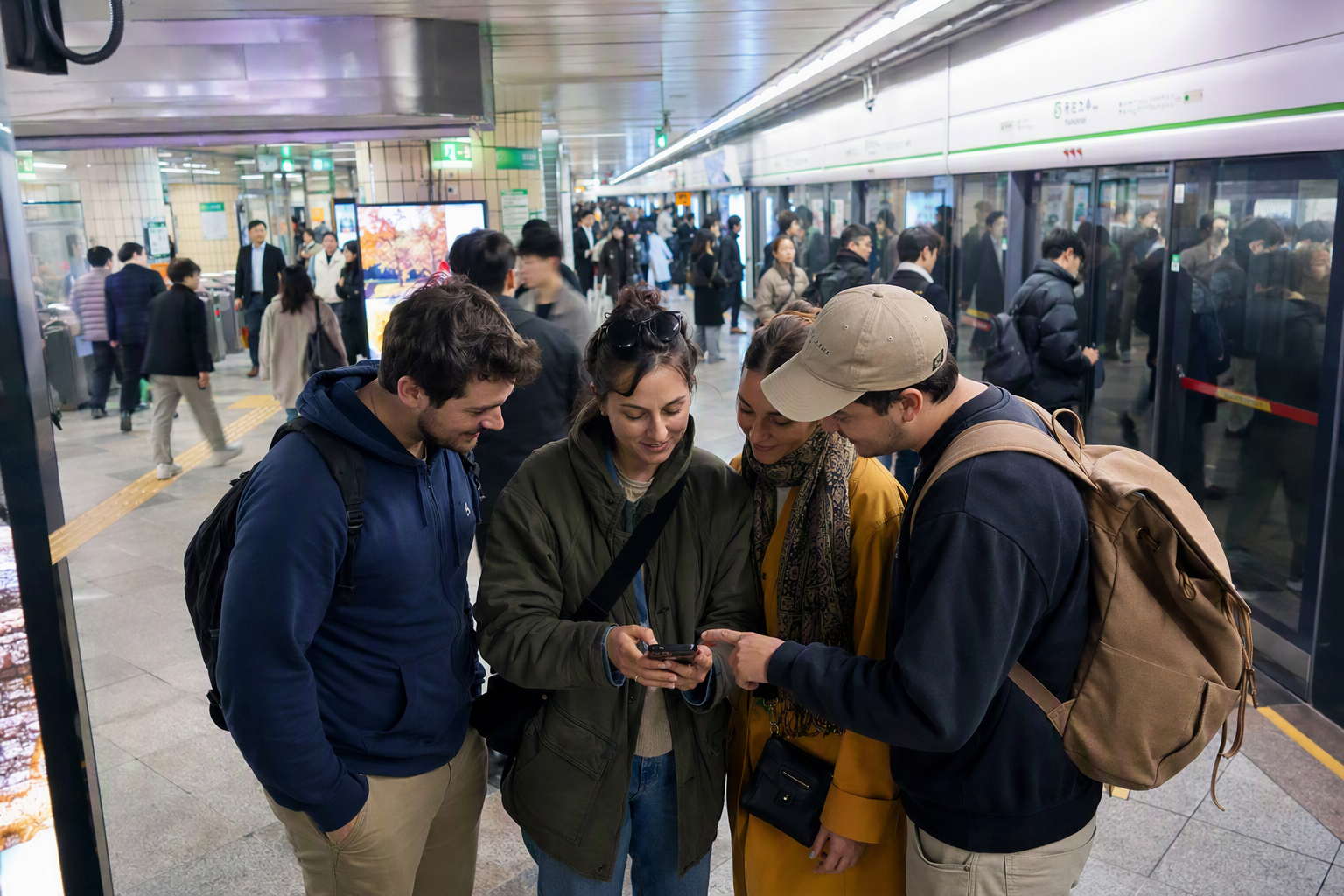
The numbered lines, with traveler personality
Seoul’s numbered lines each have their own mood. Some are simple city connectors, some stretch far into the suburbs, and one or two require a little extra attention because of branches or express trains.
| Line | What it does well | Watch for |
|---|---|---|
| Line 1, dark blue | A long trunk linking central Seoul with areas toward Suwon, Incheon, and Cheonan | Branches and final destinations matter. The same line color can lead in very different directions. |
| Line 2, green | A circular line connecting major north-of-river and south-of-river hubs | It is convenient and very busy. Do not force every route through it just because it looks familiar. |
| Line 3, orange | Connects the Goyang and Ilsan side with Gangnam-bound travel | Long cross-city rides can feel smoother than multiple awkward transfers. |
| Line 4, sky blue | A north–south trunk with extensions beyond Seoul | Check direction and destination, especially when heading toward outer sections. |
| Line 5, purple | Links Gimpo Airport with downtown-facing travel and continues across the city | It is long, so station count matters more than the line looking direct on the map. |
| Line 6, brown | Useful around the World Cup Stadium and Itaewon axis | Handy for neighborhood-to-neighborhood movement without always dropping into the busiest core. |
| Line 7, olive | Connects the Uijeongbu side with Gangnam-side travel | A strong cross-city option when Line 2 is not the cleanest route. |
| Line 8, pink | Serves southern Seoul and Seongnam, including Garak Market and Munjeong outlets | Great for targeted southern routes rather than general city wandering. |
| Line 9, gold | Links Gimpo Airport and Gangnam with local and express services, with express trips around 30 minutes on the key airport–Gangnam corridor | Express trains skip stations. Check whether your stop is served before boarding. |
Line 2 is the heavyweight of the numbered system. In 2024, it carried about 719,000 passengers a day, the highest daily ridership among Seoul Metro’s listed lines. That popularity is exactly why it appears in so many route suggestions, but it is also why a slightly less obvious route on Lines 3, 5, 7, or 9 can sometimes feel calmer.
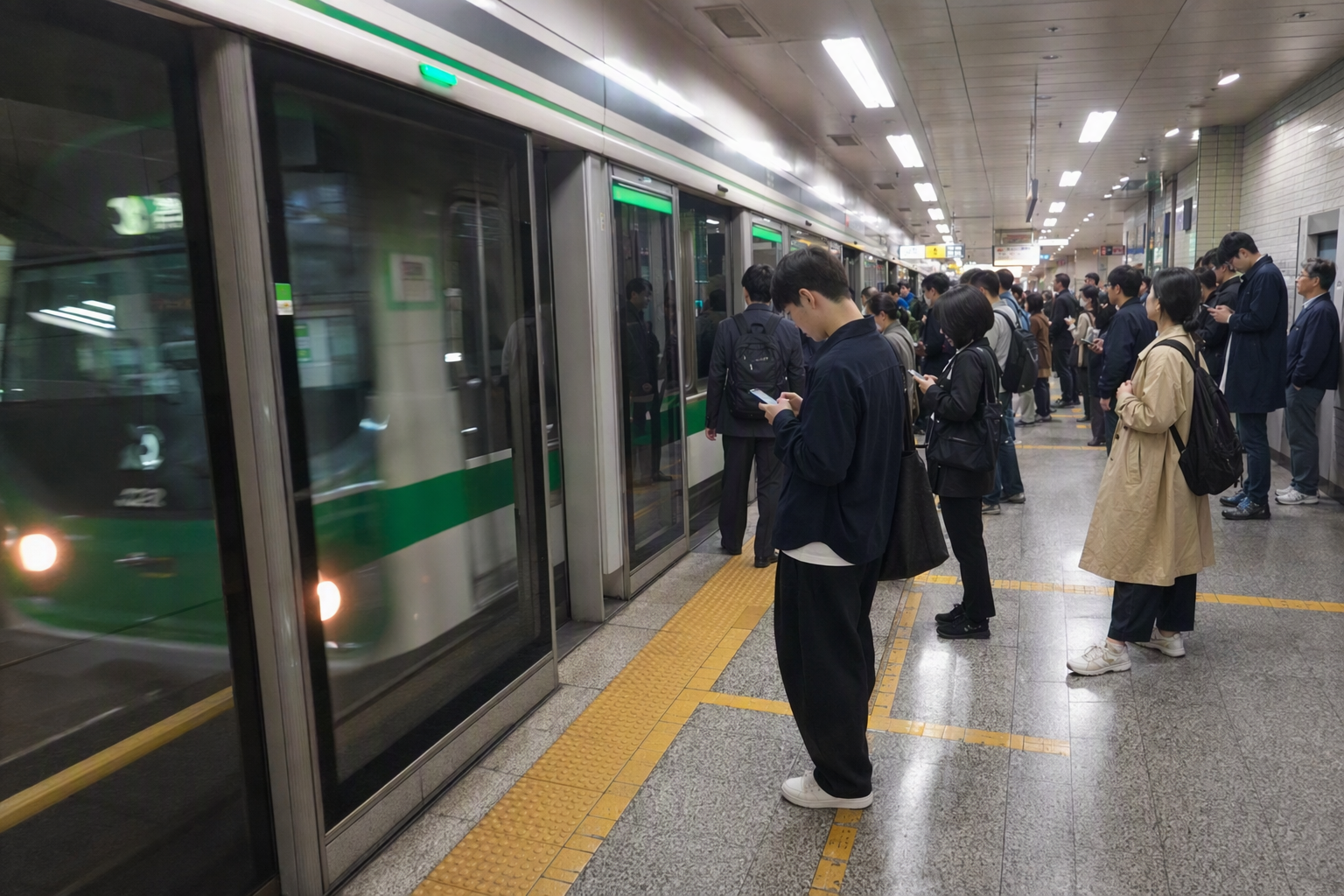
Line 2 is the comfort line, but do not let it bully the itinerary
Line 2’s green circle is easy to recognize, and it connects many of the city’s big activity zones. That makes it reassuring, especially on a first day in Seoul. The trade-off is that circular lines can tempt people into riding around the long way. If a route app suggests another numbered line with fewer transfers or a more direct path, it is usually worth trusting.
A good Seoul subway day is not about riding the most famous line. It is about making the fewest irritating transfers.
Line 9 rewards people who read the platform signs
Line 9 is one of the most useful lines for airport-side and Gangnam-side movement because it has both local and express trains. The express pattern is the reason the Gimpo Airport to Gangnam corridor can be so fast, but it also means not every train stops everywhere.
If your destination is an express stop, waiting for the express can be worth it. If not, a local train or a planned transfer will save backtracking. This is especially true with luggage, when a route that looks five minutes faster on paper can feel much worse after one missed stop.
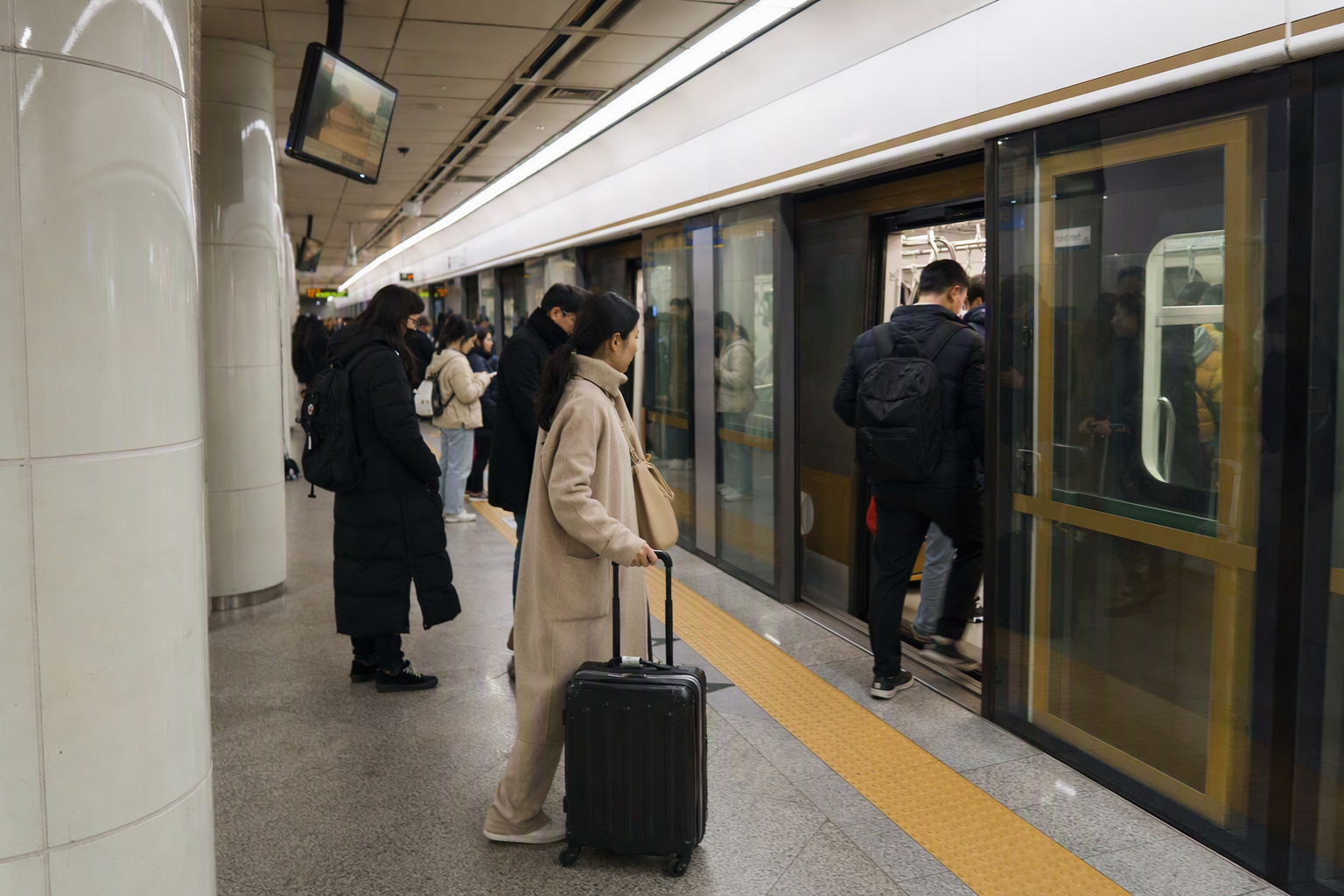
Lines 1, 3, and 4 need destination checking
Lines 1, 3, and 4 are part of a through-running system with Korail on certain sections, which is why they can stretch far beyond central Seoul. Line 1 is the classic example: it can connect toward Incheon, Suwon, and Cheonan, but not every train goes to the same branch.
The line color gets you to the right family of trains. The final destination gets you onto the right train.
Airport, suburbs, and day-trip routing without overcomplicating it
For airport movement, Gimpo Airport is the easier subway story. Lines 5 and 9 both serve the airport side, and Line 9’s express service is especially useful for Gangnam-bound trips, with the key corridor taking around 30 minutes.
For Incheon Airport, expect to use the Airport Railroad system rather than imagining that Line 9 continues directly there. A Line 9–Airport Railroad through-service project has been discussed and requires dual-voltage trains and major investment, but it is not something to build a travel plan around unless official passenger service has been clearly announced. Airport Railroad ordinary trains are part of the integrated metropolitan fare system, while special airport or premium services can have different fare rules, so check the exact option your route app recommends.
For day trips and outer-city plans, the subway can take you impressively far. Line 1 reaches toward Suwon, Incheon, and Cheonan; Line 3 reaches the Goyang and Ilsan side; Line 7 stretches toward Uijeongbu and Gangnam-side travel; Line 8 is useful for Seongnam and southern Seoul. The trade-off is time. Long suburban rides are where final destination, train frequency, and last-train checks matter more than they do for short central hops.
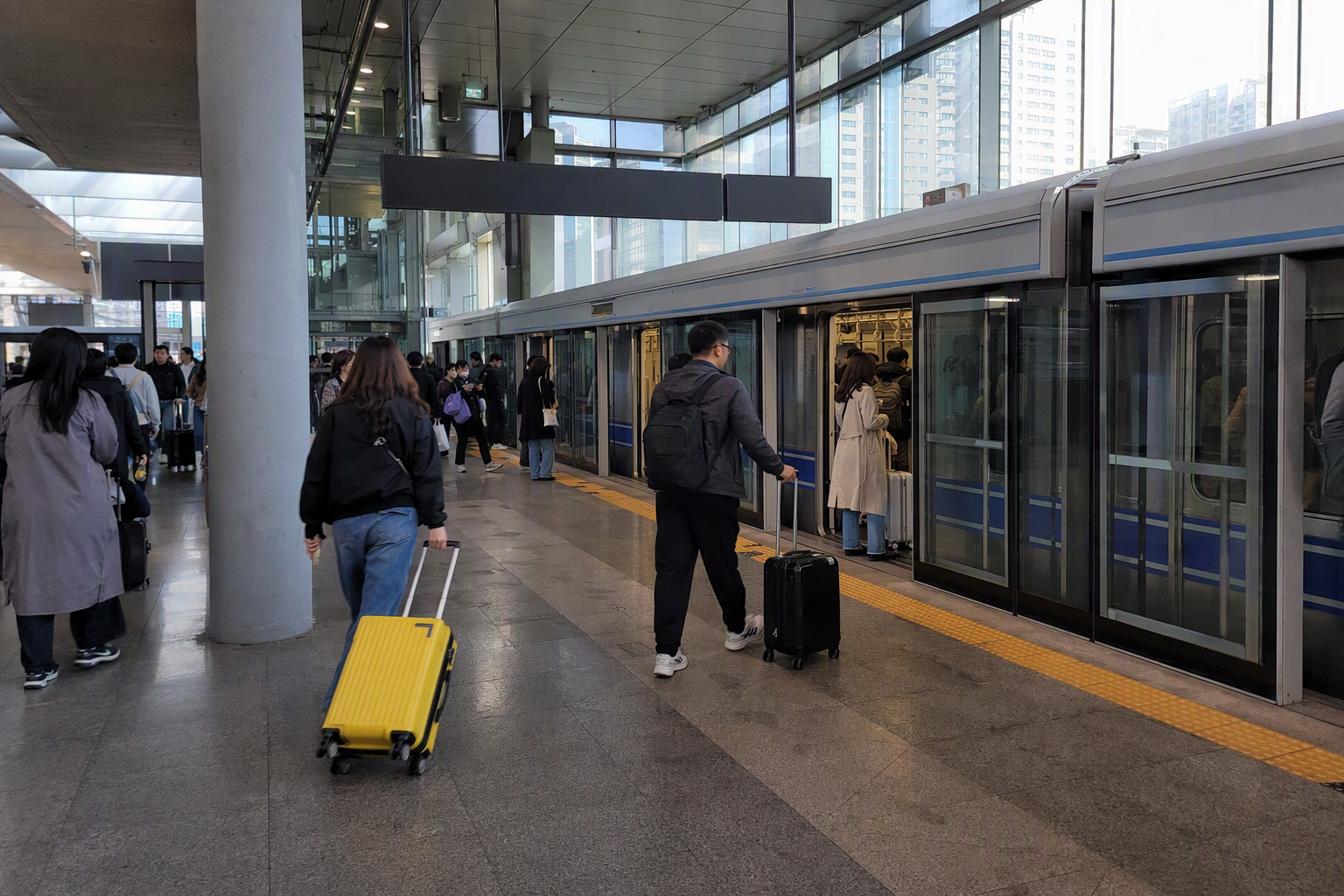
Maps, signs, and station help are getting better
Seoul’s subway map had its first major redesign in about 40 years and won a Red Dot Design Award in 2024. That sounds like a design-world detail, but it has a practical effect: the network is too large for a messy map. Clearer line shapes, transfer points, and colors make real travel less tiring.
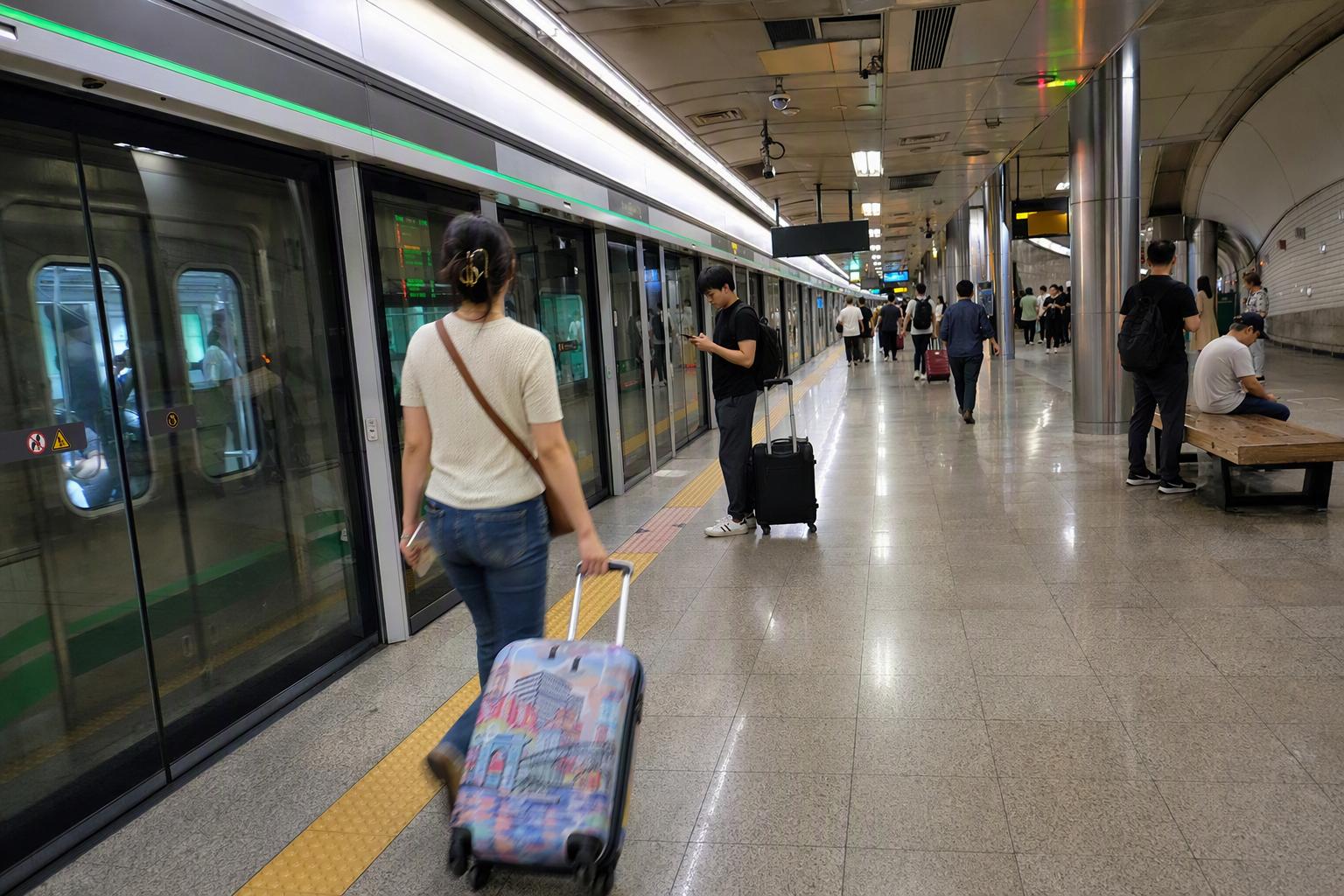
The stations themselves also have features that visitors tend to appreciate quickly. Platform screen doors are installed across Seoul’s subway stations, with Lines 1–9 completed by 2009 and Korail-managed lines completed by 2023. Beyond the safety benefit, they help reduce platform dust and noise, making waiting areas feel more controlled than many older metro systems around the world.
Seoul has also introduced AI interpretation kiosks at 11 stations with high foreign visitor traffic, offering 13 languages. They are not at every station, so they should feel like a nice backup rather than your only plan. A phone route app, line color, station number, and final destination sign remain the everyday toolkit.
Tagless fare technology is also appearing in the system after a commercial rollout on the Ui-Sinseol light rail and planned expansion across hundreds of gates on Lines 1–9. Still, normal tap-in and tap-out habits are safest for visitors. If a gate clearly supports another method, follow the posted instructions; otherwise, tap your card like usual.
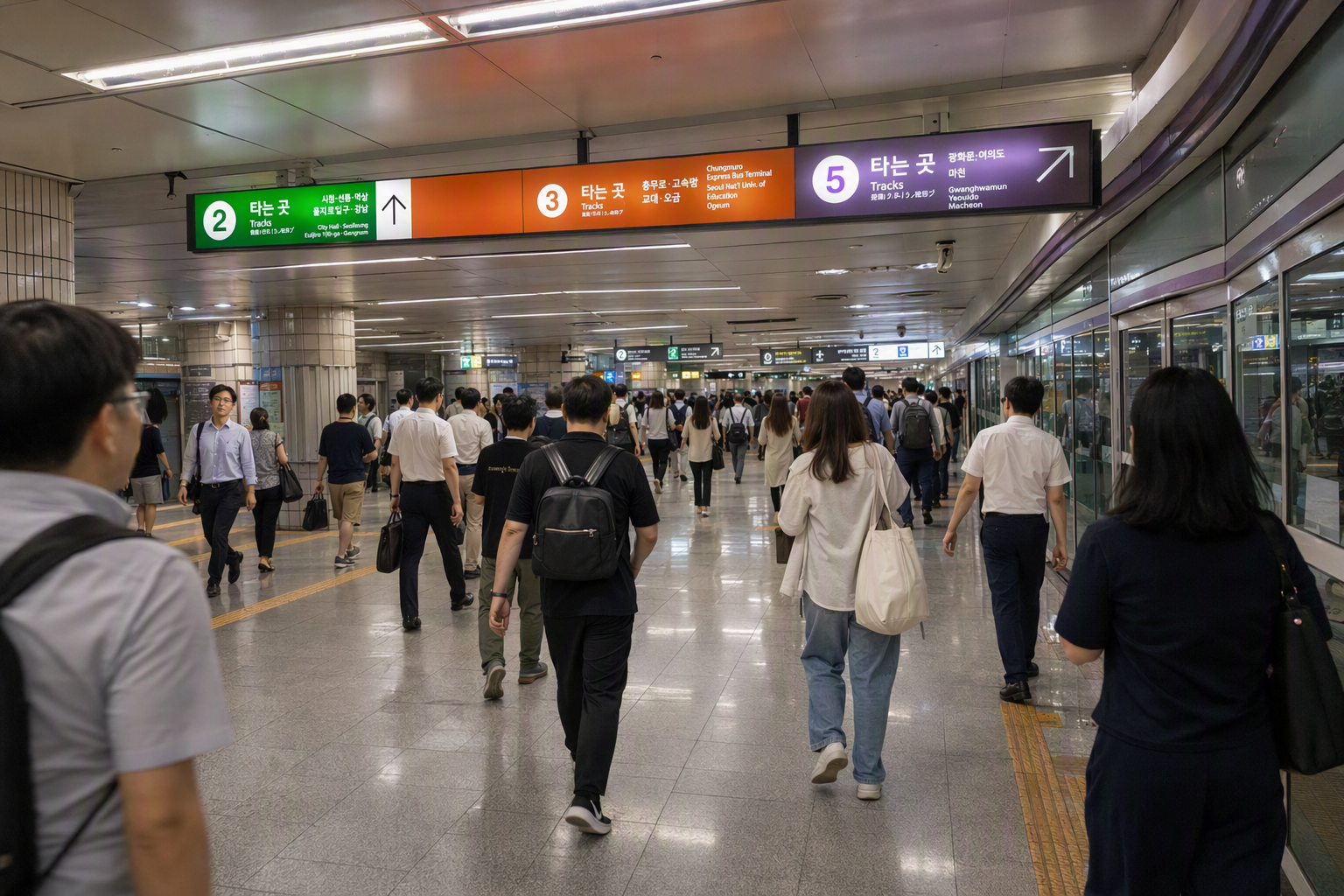
Crowds are part of the design, not a personal failure
Seoul’s subway carries a staggering number of people. Lines 1–8 alone recorded about 2.42 billion annual riders in 2024, and several individual lines handle hundreds of thousands of passengers daily. The system works because it is built for volume, but that does not mean every ride feels spacious.
A few small choices make a difference:
- Build a buffer at large transfer stations. A transfer can mean a short platform change or a long underground walk.
- With luggage, choose fewer transfers over the theoretical fastest route. One extra minute on the train is often better than stairs, corridors, and platform changes.
- On Line 9, balance express speed with comfort. The express is powerful when it matches your stop, but a local train can be simpler if you are already near your destination.
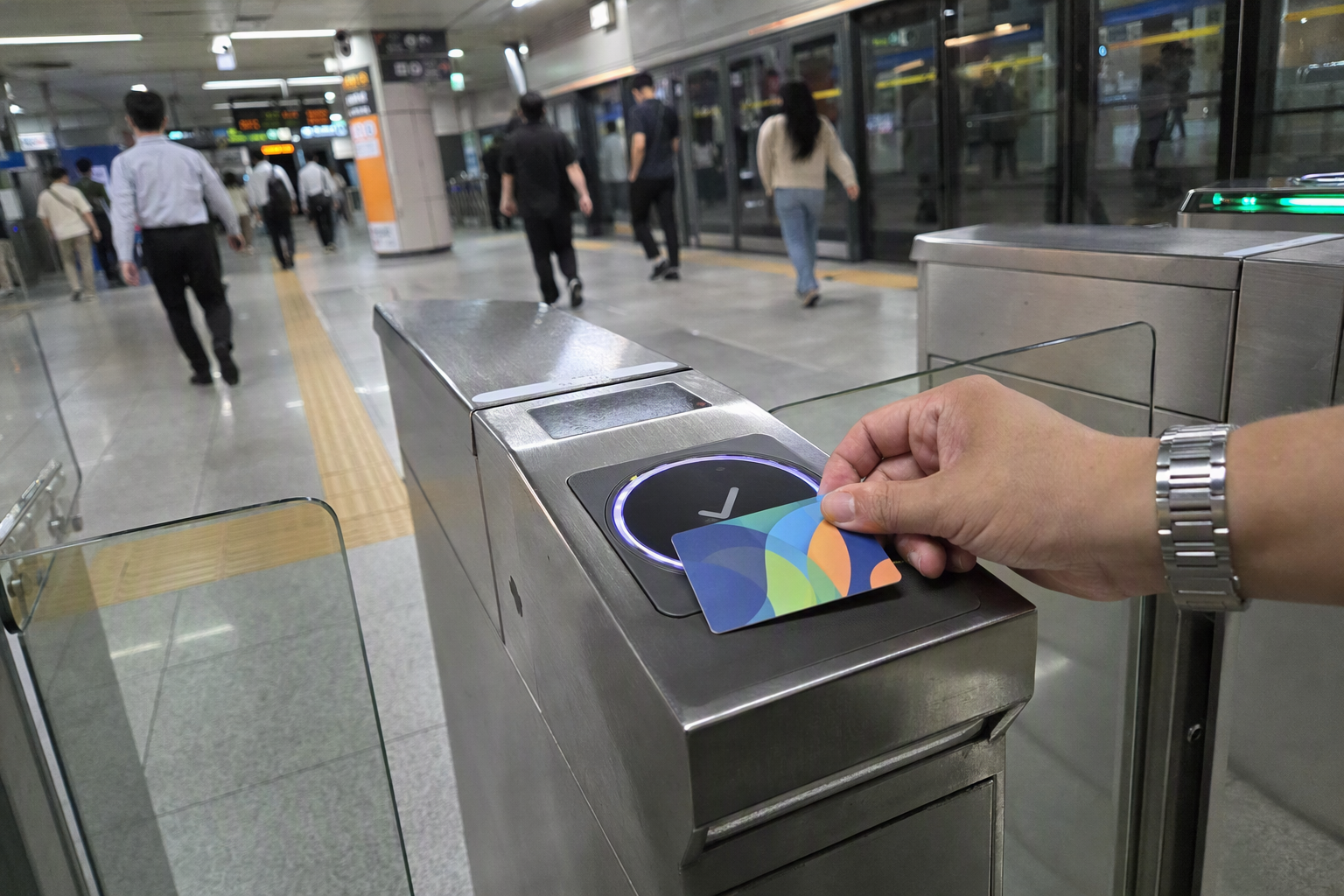
- Keep your card ready before the gate. Seoul station flows move quickly, and fumbling at the gate is the easiest way to feel flustered.
This is one of those cities where the subway map looks intimidating for about a day, then suddenly becomes part of the fun.

Why fares and policies keep changing
A little context helps explain why Seoul subway prices and card rules may look different from older travel posts. Seoul Metro is a public corporation owned by the city, and it runs one of the world’s busiest urban rail systems while carrying large public-service costs. In recent years, it has posted major operating losses, and fare discussions have been tied to free-ride policies, transfer discounts, commuter products, and debates over national versus local funding.
For travelers, the practical takeaway is not the politics. It is that fare details are not frozen. The basic adult subway fare rose from ₩1,250 to ₩1,400 in 2023, then to ₩1,550 in 2025. Unlimited cards, transfer rules, missed-tag penalties, premium-line surcharges, and airport rail products can also change. Before buying a pass or setting aside a transport budget, check the latest official page or the notice shown in your route app.
Seoul’s subway remains one of the best-value ways to move around the capital, but the smartest traveler treats fare rules as living information.
Common Seoul subway mistakes worth skipping
Riding by color only on Line 1. The dark blue line branches far beyond central Seoul. Check the final destination, not just the line number.
Forgetting that Line 9 has express and local trains. A gold train is not automatically the right gold train. Make sure your station is an express stop before boarding express service.
Missing the exit tap. Always tap out. Missed exit tags can now create extra charges, and some pass products have lockout rules.
Assuming every rail line is the base subway fare. Shinbundang, GTX-A, some light rail, and certain airport-related sections can add surcharges. Fast routes are sometimes worth the extra fare, but it is better to know before tapping.
Buying single-use tickets all week. They are fine once or twice, but the extra fare, deposit, and lack of card convenience make them clunky for normal sightseeing.
Borrowing or misusing concession cards. Seoul takes fare abuse seriously, and penalties can be expensive. Use the fare category that applies to you.
Planning around future direct services. Projects such as Line 9–Airport Railroad through-running may be discussed long before they become usable. Travel by the service that exists on your dates.
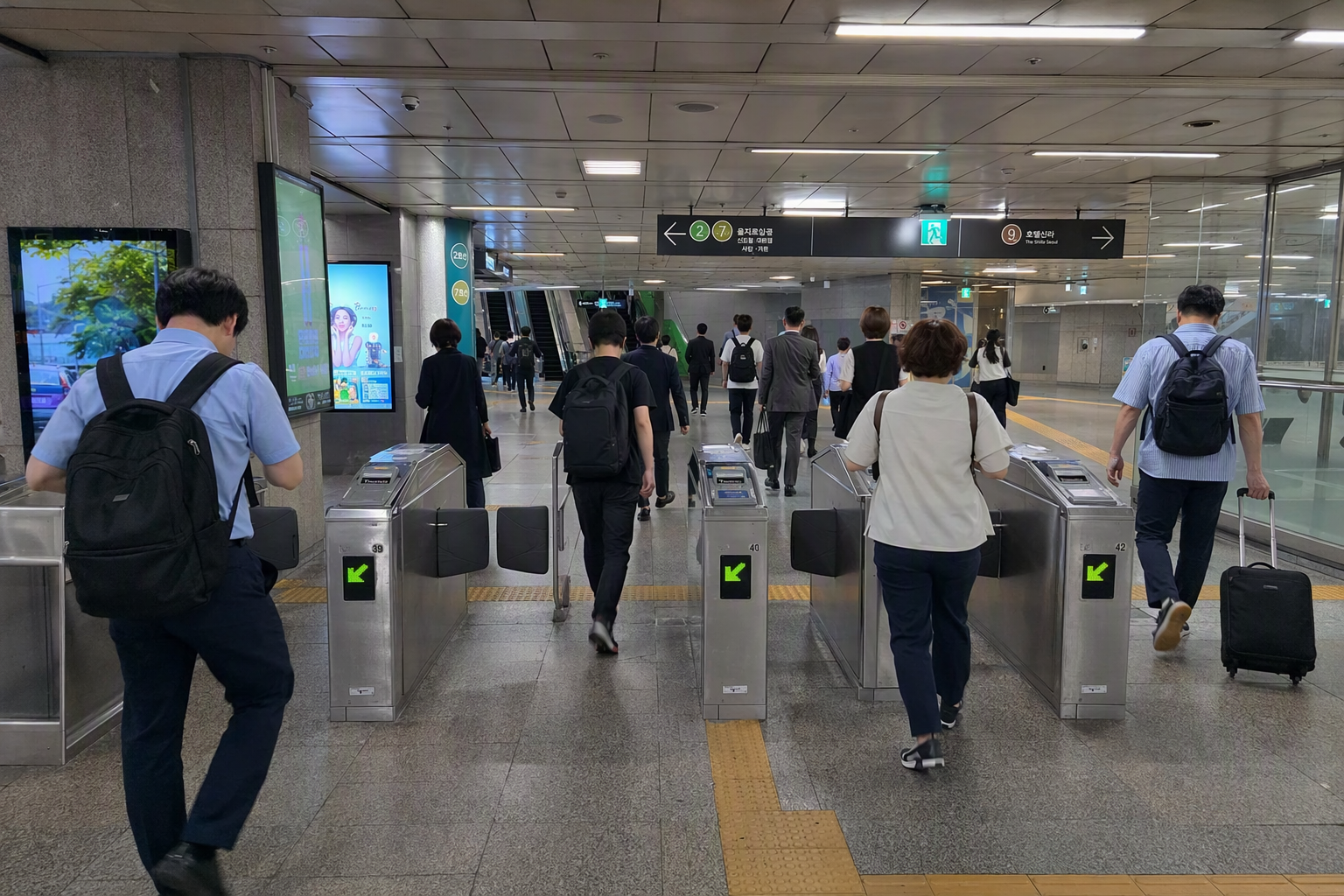
Our suggested mindset: plan by clusters, not by ambition
The Seoul subway can take you almost anywhere, which is exactly why it is easy to over-plan. A smoother day usually comes from grouping stops by side of the city or by a clean line connection. Let the subway do one or two bigger moves, then keep the rest simple with walking, buses, or a short transfer.
For airport days, give yourself a route with fewer moving parts. For suburban day trips, check the final destination and last trains before leaving. For central Seoul, resist the urge to chase the route app’s smallest time saving if it adds extra transfers. Five minutes on paper can disappear quickly in a large station.
Once the rhythm clicks, Seoul Metro feels less like a system to decode and more like the city’s quiet superpower: clean platforms, frequent trains, color-coded routes, and a map that keeps expanding with the city itself.