
USD to Korean Won: How Much Is 1,000 Won in US Dollars?
A practical Korea travel money guide with the simple ₩1,000 rule, quick conversion tables, and what exchange-rate apps do not always show.

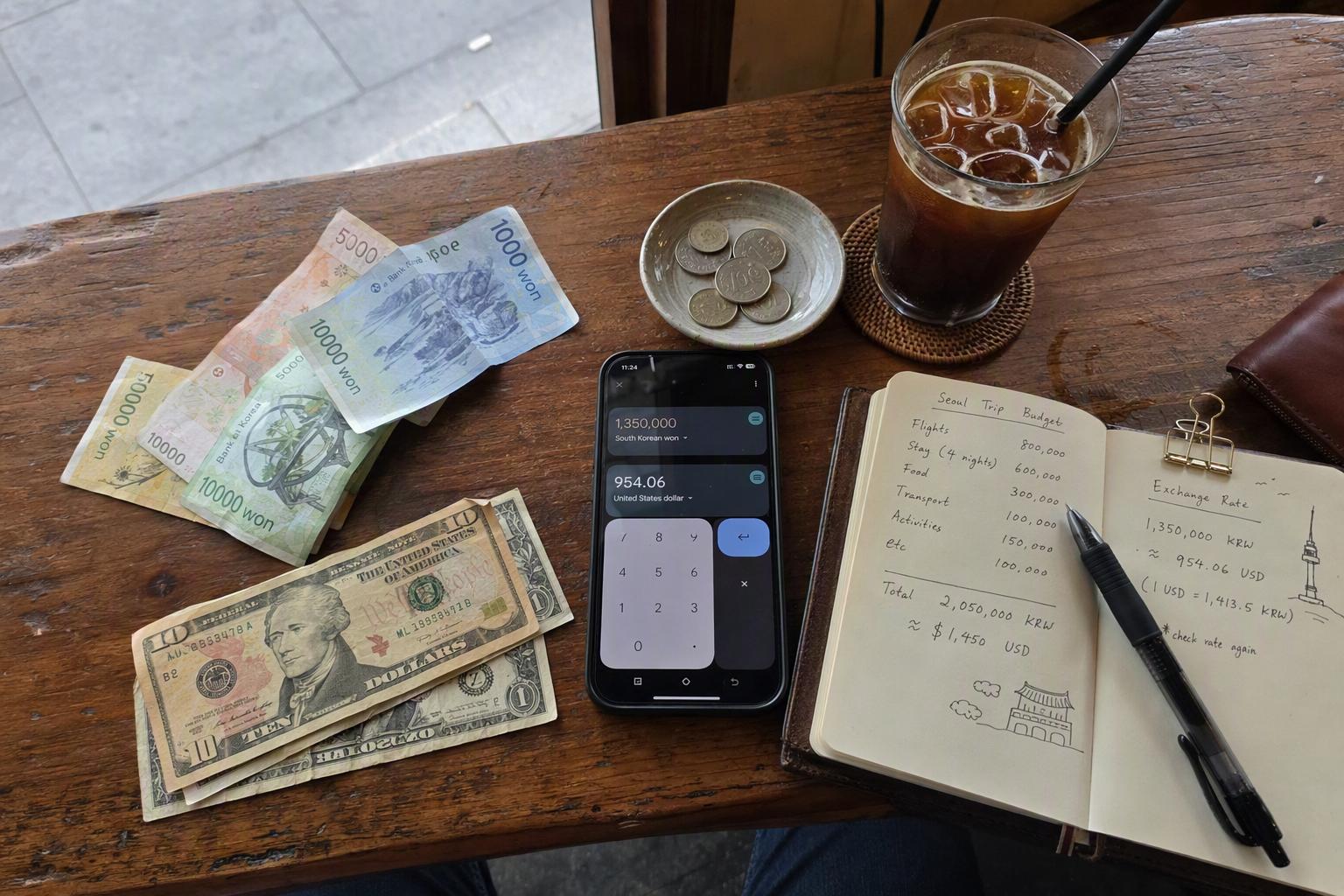
Currency math is not the most glamorous part of a Korea trip, but it quietly follows you everywhere: at the cafe counter, inside Olive Young, in a taxi, while comparing hotel prices, or when deciding whether that extra skincare set is actually a good deal.
As of 15 July 2026, major currency platforms were putting the Korean won in a fairly tight range: ₩1 was about $0.00066, which makes ₩1,000 roughly $0.65 to $0.67. Turn it around, and $1 was roughly ₩1,480 to ₩1,525 on many consumer-facing mid-market references, though some live market feeds showed higher USD/KRW levels depending on source and timing.
For travel budgeting, we like the clean mental shortcut:
₩1,000 ≈ $0.66
$1 ≈ ₩1,500
It will not match every receipt to the cent, but it is close enough to make everyday prices in Korea feel much easier.
The quick answer: 1,000 won is about 65 to 67 US cents
Using the mid-market rates clustered across major FX platforms in mid-July 2026, ₩1,000 is approximately $0.65 to $0.67.
A few simple ways to think about it:
| Korean won | Approx. USD |
|---|---|
| ₩1,000 | $0.65–$0.67 |
| ₩5,000 | $3.25–$3.35 |
| ₩10,000 | $6.50–$6.70 |
| ₩50,000 | $32.50–$33.50 |
| ₩100,000 | $65–$67 |
| ₩1,000,000 | $650–$670 |
The exact number changes constantly, so treat this as a travel estimate rather than a guaranteed exchange quote. Before exchanging a large amount, paying for a clinic booking, or sending money to Korea, check the live rate and the actual amount you will receive after fees.
The easiest Korea travel math: divide by 1,500
The neatest way to convert Korean won to US dollars in your head is:
KRW ÷ 1,500 ≈ USD
So if something costs ₩30,000, quick math says:
₩30,000 ÷ 1,500 = about $20
If a live rate is closer to ₩1,520 per dollar, dividing by 1,520 will be more precise. But while walking through Myeongdong or choosing between two lunch sets, ₩1,500 = $1 is the easiest rule to carry around.
| Korean price | Quick USD estimate |
|---|---|
| ₩1,500 | about $1 |
| ₩7,500 | about $5 |
| ₩15,000 | about $10 |
| ₩30,000 | about $20 |
| ₩75,000 | about $50 |
| ₩150,000 | about $100 |
| ₩300,000 | about $200 |
This little shortcut also helps you stop overthinking small differences. A ₩2,000 difference between two drinks is only about $1.30. A ₩20,000 difference on a shopping basket is closer to $13. Same math, very different emotional impact.

USD to KRW: how much won do you get for dollars?
Around mid-July 2026, consumer-facing mid-market references were often sitting around ₩1,480 to ₩1,525 per $1. For a quick estimate, using ₩1,500 per $1 keeps things simple.
| US dollars | Approx. Korean won |
|---|---|
| $1 | ₩1,480–₩1,525 |
| $10 | ₩14,800–₩15,250 |
| $50 | ₩74,000–₩76,250 |
| $100 | ₩148,000–₩152,500 |
| $500 | ₩740,000–₩762,500 |
| $1,000 | ₩1,480,000–₩1,525,000 |
One small but important note: this table is based on mid-market-style references, not the guaranteed cash you will receive at an exchange counter, bank, app, card issuer, or transfer service. The number that matters most is always the final KRW received or the final USD charged.
Why your currency app may not match the rate you actually get
This is where many travelers get mildly annoyed, and honestly, we understand. You check one app, it says one rate. Another app looks slightly different. Then your card statement or transfer receipt comes through with another number again.
The reason is that many displayed rates are mid-market reference rates. That is the clean rate sitting between the buy and sell side of the market. It is useful for comparison, but it is not always the rate a customer can actually use.
Different providers price currency differently:
- Wise markets itself around the real mid-market rate with transparent fees.
- Xe and Revolut display mid-market-style rates, but the final cost can depend on the service structure.
- Revolut notes weekday versus weekend markups and fair-usage limits, so timing and plan type can matter.
- OFX distinguishes interbank/reference rates from customer rates.
- XTransfer notes that bank spreads, routing, and intermediary fees can affect the final amount.
- Ria and similar services may show indicative rates that are not the same as the final send rate.
For a ₩1,000 snack, these differences are tiny. For a ₩1,000,000 shopping day, long-stay deposit, tuition payment, or medical appointment, they become much more visible.

The rate can look different by source and timing
Even on the same date, public currency feeds can show different USD/KRW numbers. In mid-July 2026, several consumer platforms clustered around roughly ₩1,490 to ₩1,500 per $1, while some trading and composite market feeds showed higher levels in the ₩1,530 to ₩1,550 range depending on timing and methodology.
That does not mean one app is necessarily fake. Currency feeds can differ because of:
- the exact timestamp
- whether the quote is live, delayed, or benchmark-style
- whether it is a consumer reference or a market composite
- the source of bid and ask prices
- regional pricing or service-specific fees
For travelers, the practical takeaway is softer: do not compare only the headline rate. Compare the amount you will actually pay or receive.
When exchange-rate differences matter, and when they do not
The won has been fairly stable over short windows around this level. Recent KRW/USD references kept ₩1,000 mostly in the $0.64 to $0.67 band, with low short-term volatility across 7-, 30-, and 90-day windows.
That means there is usually no need to refresh your exchange app every ten minutes before buying coffee. A tiny move in the exchange rate will not change your cafe budget in any meaningful way.
Where it starts to matter:
| Situation | Why the rate matters |
|---|---|
| Exchanging a few days of pocket cash | Small differences, but still worth avoiding obvious bad spreads |
| Paying for hotels or tours in USD/KRW | Check which currency gives the better final amount |
| Large shopping purchases | A 2% difference can become noticeable |
| Clinic, beauty, or long-stay payments | Compare all-in card, cash, and transfer costs |
| Sending $1,000+ to Korea | Provider ranking can change once fees are included |
For a ₩100,000 spend, a 2% exchange difference is roughly $1.30. For ₩1,000,000, it is closer to $13. For $7,000 transfers or large prepaid bookings, the gap can be much bigger, and the cheapest option may not be the one with the prettiest displayed fee.
Cash, card, app, or transfer: which way makes sense?
Korea travel spending usually ends up being a mix. Some travelers like arriving with a bit of won in hand, then using cards or apps for larger purchases. Others prefer exchanging as little cash as possible and tracking everything digitally.
The best choice depends less on the brand name and more on the final math.
Cash exchange: simple, but compare the posted rate
Cash is straightforward: you hand over USD, receive KRW, and the rate is usually clear at the counter. The trade-off is that the posted rate may include a spread compared with the mid-market rate you saw online.
A quick habit: before exchanging, calculate roughly how much won you expect using $1 ≈ ₩1,500. If $100 should be around ₩150,000 before fees and spreads, a final amount far below that deserves a second look.
Cards and multi-currency apps: convenient, but read the fine print
Cards and apps are easy for everyday travel, but the exchange rate is not the only thing in play. Some providers add plan-based fees, weekend markups, fair-usage fees, or card issuer charges.
For example, Revolut notes weekend FX surcharges and fair-usage thresholds, while Wise emphasizes mid-market exchange with transparent fees. That does not automatically make one option best for every traveler; it means the timing, plan, and amount matter.
A very practical move is to compare the effective final charge, not just the beautiful rate on the first screen.

International transfers: compare the amount received, not the fee label
For travelers staying longer in Korea, students, remote workers, or anyone paying a Korean account directly, transfer comparisons can be surprisingly counterintuitive.
In one 2026 comparison for a $1,000 USD to KRW transfer, Wise came out cheapest among the listed options by amount received. But in a separate July 2026 comparison for a $7,000 transfer, OFX delivered the highest KRW received among the compared providers, even though other services showed strong rates or different fee structures.
That is exactly why we do not love comparing only the service fee. A zero-fee transfer with a weaker rate can lose to a transparent-fee transfer with a stronger rate, and the ranking can flip again when the amount changes.
The clean comparison is:
How many won arrive at the end?
Not the headline fee. Not only the exchange rate. The final KRW.
A small note on the weak won
The Korean won has been relatively weak against the US dollar, with USD/KRW elevated around the high ₩1,400s to ₩1,500s in recent periods. Depending on the provider and time window, one-year USD/KRW performance showed the won down meaningfully against the dollar.
There are several moving parts behind that: global dollar strength, the US-Korea interest-rate gap, overseas investment flows by Korean residents, portfolio flows into US equities, and broader market behavior around tech and risk sentiment. At the same time, Korea still has strong external fundamentals in several areas, and some institutional views have expected potential won appreciation over the medium term if capital flows improve, bond inflows materialize, or policy conditions shift.
For a visitor, the important part is not forecasting the won. It is simply this: USD budgets have recently converted into more won than they would have at a stronger-won level, but exchange rates can move. Build your Korea budget with a little cushion, especially for prepaid hotels, beauty clinics, shopping, or activities priced in won.
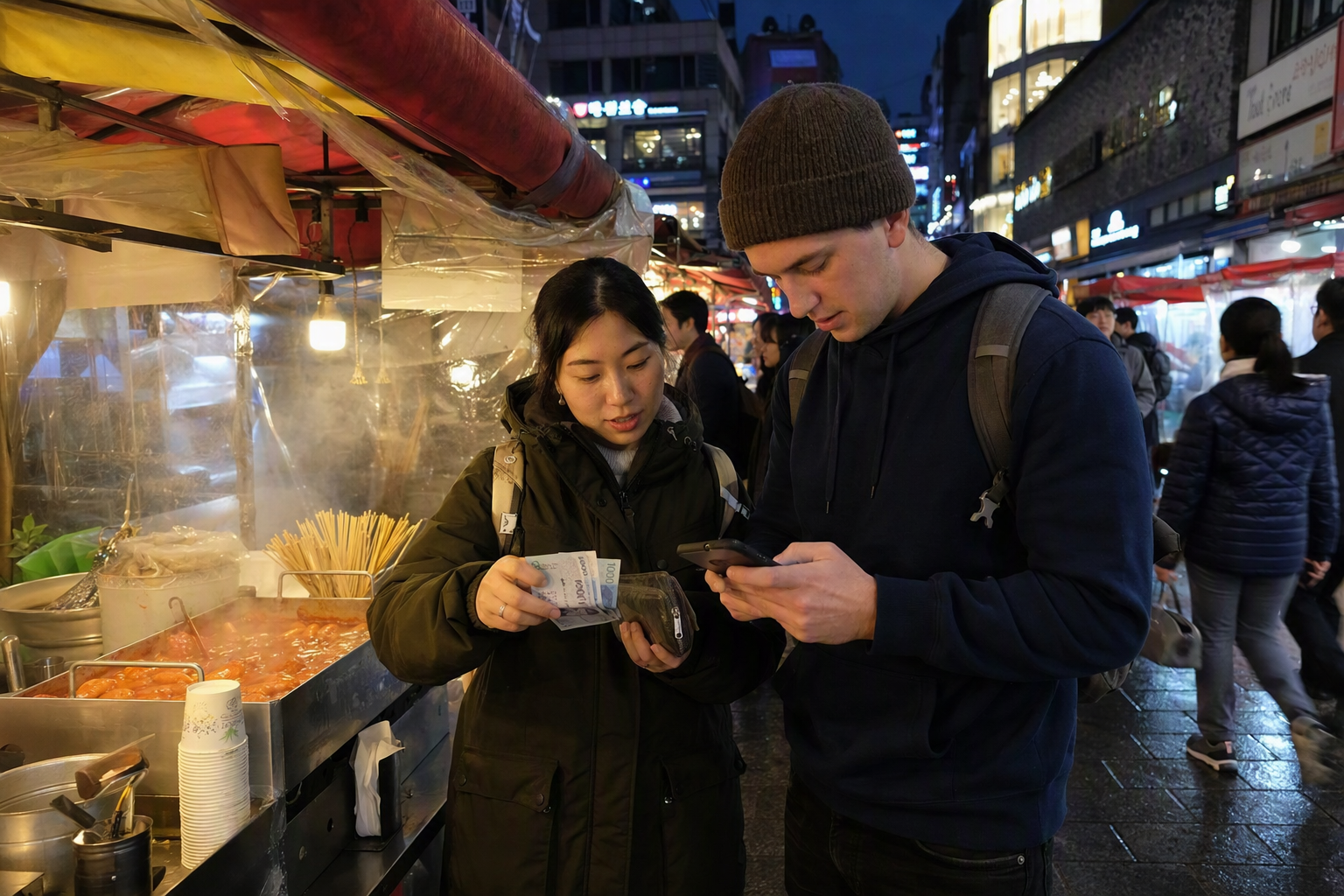
Common money mistakes to avoid in Korea
Mistake 1: Treating ₩1,000 like $1
This is the classic early-trip brain glitch. Because ₩1,000 looks like a neat unit, it is tempting to read it as one dollar. In the current range, ₩1,000 is closer to two-thirds of a dollar, not one full dollar.
That means ₩10,000 is about $6.50 to $6.70, not $10.
Mistake 2: Comparing only exchange rates, not fees
A provider can show a strong exchange rate and still charge a fee. Another can advertise a low or zero fee but use a less favorable rate. For larger amounts, always look at the final won received or final dollars charged.
Mistake 3: Forgetting weekend or plan-based app markups
Some services have different rules depending on the day, plan, or usage level. Revolut, for example, details weekend FX markups and fair-usage limits. If you use an app with timing-based fees, exchanging on a weekday may be cleaner.
Mistake 4: Panicking over tiny rate movement
Recent short-term KRW/USD movement has been fairly narrow. Unless you are moving a large amount, a small rate change is usually less important than avoiding obvious fees or bad spreads.
Mistake 5: Trusting one live quote as the universal truth
Wise, Xe, Revolut, Ria, Bloomberg-style feeds, and other platforms can show different numbers because they are not all quoting the same thing at the same moment. Use them as references, then confirm the rate that applies to your actual transaction.
Creatrip’s practical travel take
For day-to-day Korea travel, we would keep it simple:
- Use ₩1,000 ≈ $0.66 for quick price reading.
- Use $1 ≈ ₩1,500 for mental conversion.
- For small purchases, do not chase tiny rate differences.
- For large payments, compare the final amount after fees and spreads.
- If using an FX app, check weekend, fair-usage, and plan rules.
- Before exchanging or transferring a large amount, verify the latest live rate.
The won can look intimidating because Korean prices have more zeros than US prices. After a day or two, it starts to feel natural: ₩15,000 is about $10, ₩30,000 is about $20, and ₩150,000 is about $100. Once that clicks, the rest of your trip feels a little smoother.
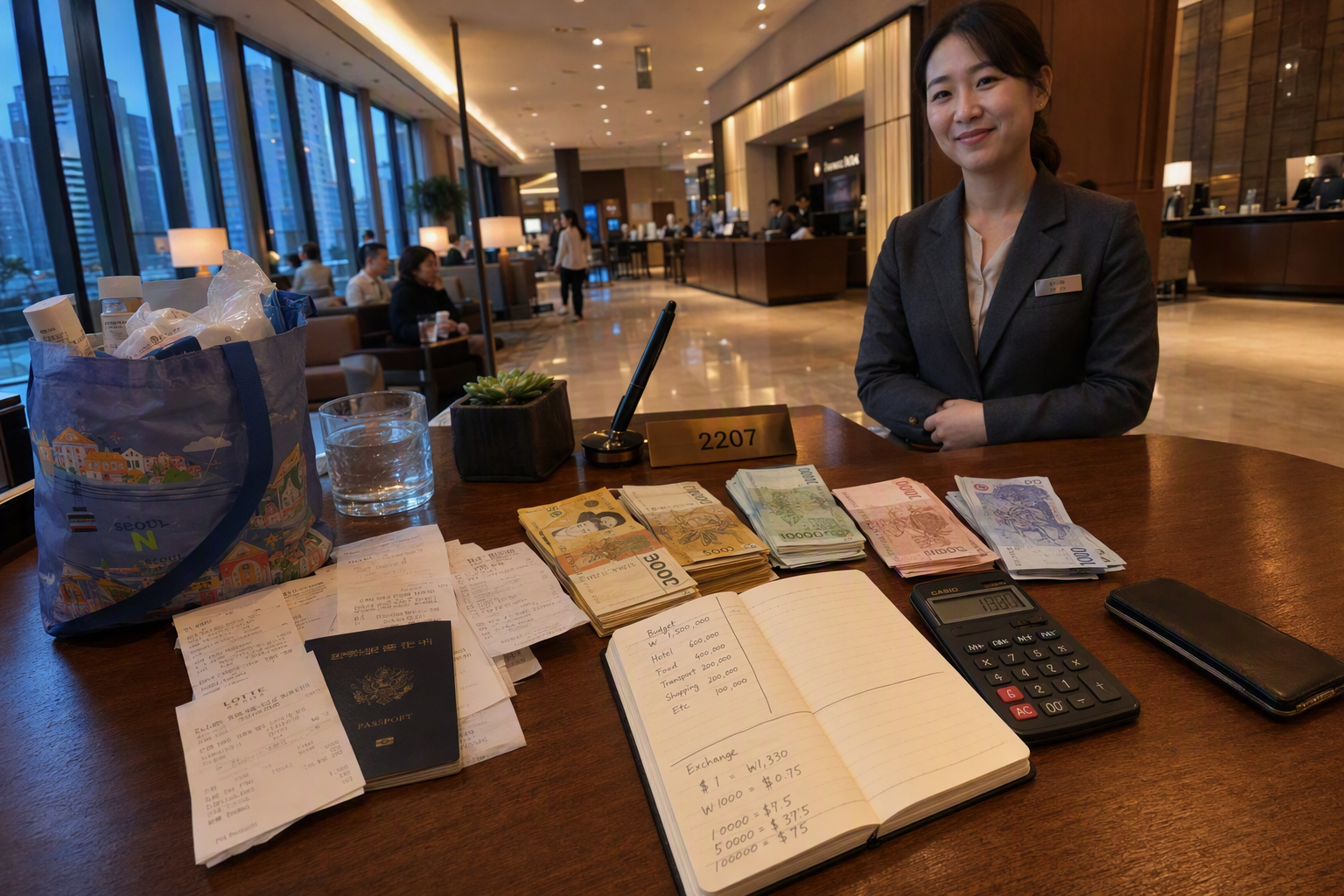
Pocket cheat sheet
| Quick conversion | Travel-friendly estimate |
|---|---|
| ₩1,000 | about $0.66 |
| ₩10,000 | about $6.60 |
| ₩50,000 | about $33 |
| ₩100,000 | about $66 |
| $10 | about ₩15,000 |
| $50 | about ₩75,000 |
| $100 | about ₩150,000 |
| $1,000 | about ₩1,500,000 |
Exchange rates move all day, and the rate on your card, app, cash exchange, or transfer receipt may differ from the mid-market reference. Still, for the everyday rhythm of traveling in Korea, this simple rule works beautifully:
Drop the last three zeros, then multiply by about 0.66.
₩30,000 → 30 × $0.66 → about $20.