
Korea Travel Visa Guide 2026: K-ETA, Visa-Free Entry, C-3 Visas, and Arrival Cards
A clear Creatrip-style look at the paperwork that matters before your flight to Korea, minus the panic and unofficial visa-site traps.


Visa paperwork is not the prettiest part of planning Korea, but it has a way of setting the mood for your whole arrival day. A smooth landing at Incheon, a quick immigration line, then straight into the AREX or airport bus? Lovely. Realizing too late that you used the wrong website or confused K-ETA with a visa? Less lovely.
For short-term visitors, Korea’s entry system usually falls into a few simple paths: visa-free entry with K-ETA, visa-free entry during the temporary K-ETA exemption, a short-stay C-3 visa, and arrival or health forms that may still apply even when no visa is needed.

Start with the passport you will actually use
Korea looks first at the passport you enter with, not where you live, where your flight departs from, or another nationality you are not using on this trip. That matters for dual citizens, long-term residents abroad, and anyone booking a multi-country trip through Asia.
Your travel purpose matters too. A casual holiday, short family visit, conference attendance, medical tourism, company incentive trip, and paid work are not treated the same. Short-term tourism is usually the simplest category, but Korea does not treat K-ETA or a tourist visa as a workaround for employment, long-term study, residence, or repeated commercial activity.
A neat way to think about it:
| Your situation | Likely route | The part to check carefully |
|---|---|---|
| Your passport is visa-free, but not temporarily K-ETA exempt | K-ETA before travel | Apply only through the official K-ETA site or app |
| Your passport is visa-free and temporarily K-ETA exempt | Visa-free entry without K-ETA | You may still need an arrival card |
| Your passport is not visa-free for Korea | C-3 or another Korean visa | Follow your local Korean embassy, KVAC, VFS, or designated agency rules |
| Your purpose is work, long-term study, residence, or paid service | Not a tourist route | Use the correct visa or status before traveling |
K-ETA is not a visa, and that distinction matters
K-ETA, short for Korea Electronic Travel Authorization, is for eligible visa-free travelers who need pre-travel authorization before boarding a flight or ship to Korea. It is not a visa, and approval does not guarantee entry. Final permission is still decided by Korean immigration at the port of entry.
That sounds technical, but it has a real travel impact. If your purpose does not match short-term visa-free entry, or if your application details and passport do not line up, K-ETA approval alone will not fix the problem.
K-ETA validity and stay length are not the same thing
Current K-ETA approvals are generally valid for 3 years, or until your passport expires, whichever comes first. During that validity period, K-ETA can be used for multiple visits.
But a 3-year K-ETA does not mean you can stay in Korea for 3 years. Your allowed stay is still based on your passport nationality and Korea’s visa-free rules.
A few examples from official K-ETA stay-period guidance:
- Canada: up to 6 months
- Kazakhstan: up to 30 days per visit, with a maximum of 60 days within 180 days
- Russia: up to 60 days per visit, with a maximum of 90 days within 180 days
- Portugal: up to 90 days per visit, with a maximum of 90 days within 180 days
Those 180-day cumulative limits are easy to miss if you visit Korea often. Multiple entries do not reset the clock.
K-ETA cost, timing, and the unofficial-site problem
Official K-ETA applications are handled through www.k-eta.go.kr or the official K-ETA mobile app. The official fee is 10,000 KRW, with an additional online card or payment fee, and it is not refunded if the application is rejected. Fees and procedures can change, so the official site is always the place to confirm the latest amount before paying.
K-ETA is usually reviewed within 72 hours, but it can take longer, and there is no official urgent processing service. We would not leave it for the airport taxi ride. A few days of breathing room is far more pleasant, especially if you have past overstays, an old entry refusal, a changed passport, or anything in your travel history that may need extra review.
Korea has warned travelers about unofficial K-ETA websites charging much higher fees or advertising fast-track services. The cleanest rule: if it is not the official K-ETA website or app, do not enter your passport and card details there.

Temporary K-ETA exemption through December 31, 2026
Many travelers from major tourism markets can currently enter Korea visa-free without applying for K-ETA because of Korea’s temporary K-ETA exemption. The exemption has been extended through December 31, 2026, Korea Standard Time.
Official tourism guidance lists the following countries and regions for the temporary K-ETA exemption:
Japan, Thailand, Hong Kong, Singapore, Macao, the United States including Guam, Canada, the United Kingdom, Germany, France, Italy, the Netherlands, Spain, Poland, Sweden, Finland, Norway, Belgium, Denmark, Austria, Australia, and New Zealand.
This exemption only helps travelers who are already eligible for visa-free entry. It does not turn a visa-required passport into a visa-free one.
Because eligibility lists can be updated, and because your exact passport is what matters, it is still smart to confirm on the official K-ETA portal before your flight. Older screenshots and travel forum posts are not worth betting your Korea trip on.
Should exempt travelers still apply for K-ETA voluntarily?
You can. Travelers who are temporarily exempt may still apply for K-ETA voluntarily, pay the normal fee, and wait for approval. The main practical benefit is that valid K-ETA holders are generally exempt from submitting the arrival card when entering without a visa.
For a one-time leisure trip, skipping K-ETA and filling out the arrival card is usually the easier trade. For frequent travelers, business visitors, or anyone who strongly prefers a pre-cleared document flow, voluntary K-ETA can still make sense.
The arrival card is where many travelers get surprised
K-ETA exemption does not automatically mean no forms at all. Korea now has an official e-Arrival Card system at www.e-arrivalcard.go.kr, run by the Ministry of Justice’s immigration office. It is free and works as an online alternative to the paper arrival card.
You can submit the e-Arrival Card from 3 days before arrival, based on Korea Standard Time. Once submitted, it expires automatically after 72 hours or after Korean immigration inspection is completed.

If you are required to submit an arrival card, the electronic version and the paper version are alternatives. Paper cards have been operating alongside the online system, but digital rules and transition dates can change, so check the official e-Arrival Card site close to departure.
Who usually does not need an arrival card?
The exemption list includes groups such as Korean nationals, foreign residents with an Alien Registration Card or permanent residence card, valid K-ETA holders, some group visa or group e-visa tourists, certain visa-free group tourists through Yangyang or Muan, and foreign crew members.
For most short-term travelers, the important practical split is this:
- Entering visa-free with a valid K-ETA: you generally do not need the arrival card.
- Entering visa-free because your passport is temporarily K-ETA exempt, without holding K-ETA: plan on submitting the e-Arrival Card or paper arrival card unless another exemption applies.
- Entering with a Korean visa: arrival card rules may still apply, even if you also happen to hold K-ETA.
It is not a difficult form, but it is one of those small airport details that feels much better handled before the seatbelt sign turns on for landing.
Q-Code and health forms are separate from visa rules
Korea’s health and quarantine process sits beside the visa process, not inside it. Travelers arriving from designated quarantine management areas may need to complete Q-Code or a paper health condition questionnaire.
If this applies to your route, skipping the health screening requirement can lead to a fine of up to 10 million KRW. That does not mean every traveler needs Q-Code every time, but it does mean your departure point, transit route, and recent travel history can matter. Check the latest health entry guidance before flying, especially after visiting multiple countries.
When you need a visa: the C-3 short-stay route
If your passport is not eligible for visa-free entry, or if your purpose requires a visa, Korea’s short-term visitor visas usually fall under the C-3 category.
Common C-3 subtypes include:
| Visa type | Common use |
|---|---|
| C-3-1 | Short-term general visit |
| C-3-2 | Group tourism |
| C-3-3 | Medical tourism |
| C-3-4 | General business visit |
| C-3-8 | Short-term visit for overseas Koreans |
| C-3-9 | General tourism |
| C-3-10 | Pure transit visa |
For a regular sightseeing trip, C-3-9 is the general tourism visa. It is not for working in Korea, taking long-term study, or living in Korea. C-3 stays are generally short-term, often up to 90 days depending on the visa and local decision, and extensions are usually limited to unusual circumstances.
Where C-3 applications are handled
C-3 tourist visa applications are usually handled through the Korean embassy or consulate responsible for your place of residence, or through local channels such as KVAC, VFS, or designated travel agencies. Korea’s central visa portal is useful for visa categories, e-Forms, and status checks, but the local embassy or visa center often controls the real-life checklist, appointment rules, processing time, and fee payment method.
That local detail matters. Two travelers applying for the same C-3-9 tourism visa from different countries may face different document lists.
The basic C-3 document set
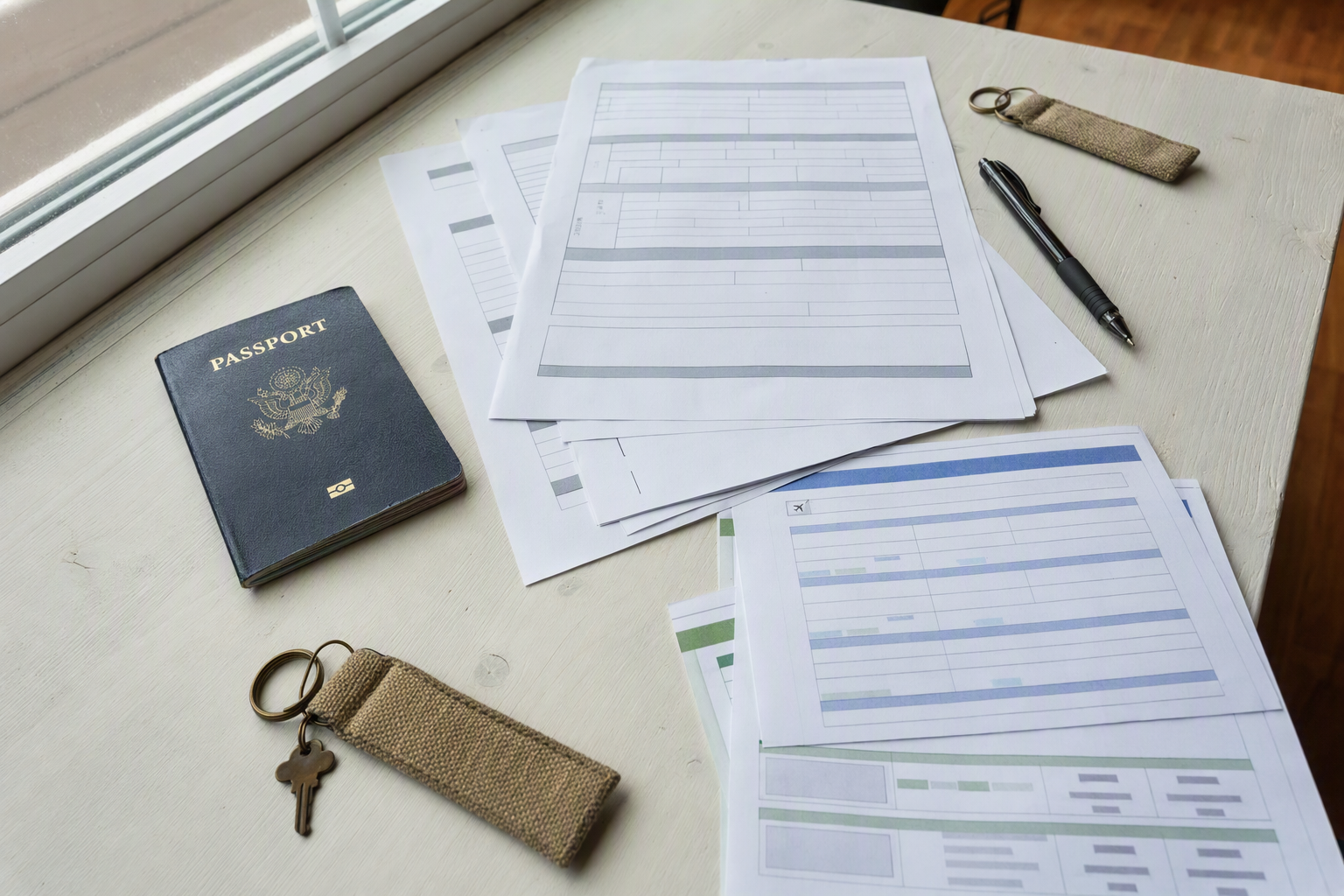
The exact checklist depends on your embassy or visa center, but the common base usually includes:
- Korean visa application form, often Form No. 17 or an e-Form printout
- Passport
- Color passport photo, commonly 3.5 cm × 4.5 cm
- Visa fee
- Documents matching your purpose of stay
Tourist applications often ask for items such as accommodation proof, itinerary, round-trip or onward flight booking, financial proof, employment or student documents, and sometimes tax or bank records. Do not treat a general checklist online as final unless it comes from your local Korean mission or appointed visa center.
Local visa rules can feel surprisingly local
This is where Korea visa planning gets a little less tidy. The central visa categories are national, but the application process is local.
For example, VFS guidance for C-3-9 tourism applications in India includes items such as a passport valid for at least 6 months, an online application form, occupation proof, income tax documents, recent personal bank statements, a health condition report, a declaration form, and extra documents depending on whether the applicant is employed, self-employed, or a student.
In Singapore, some C-3 short-term applications are handled only through designated visa or travel agencies, not personal walk-in submission. A C-3-9 company incentive travel visa, for instance, has been listed as requiring designated travel agency submission, with no urgent or express processing.
For the Korean Embassy and Consular Office in Washington, DC, visa service rules have included in-person applications by online appointment, jurisdiction limits, and a usual processing window of around 2 to 3 weeks. Non-U.S. citizens applying there may need to show U.S. immigration status documents.
In the Philippines, Korean visa applications have been routed through designated travel agencies for many applicants, with walk-in submission limited to certain cases such as Korean family members, visa issuance confirmation number holders, official government travel, and urgent humanitarian reasons.
The takeaway is not that these examples apply to everyone. It is that your local Korean mission’s page is not a small footnote; it is the page that can decide whether you need an appointment, an agency, six months of bank statements, or several weeks of lead time.
Korea now uses label-free visas
Korea no longer issues visa stickers or labels in passports through embassies. Since the global switch to label-free visas, approved applicants print a Visa Grant Notice from www.visa.go.kr using the Application Status or Issue menu.
Bring the printed notice with your passport when you travel. It can be printed in color or black and white, but do not assume a missing sticker means nothing was issued. For Korea, the grant notice is the document to keep.
You can also use Korea Visa Portal tools to check application status and print the notice. For immigration-related questions, Korea’s immigration contact center is 1345 inside Korea and +82-1345 from overseas.
Common Korea entry mistakes we would avoid
Using a paid unofficial K-ETA site
This is the big one. The official K-ETA fee is 10,000 KRW plus payment charges. Unofficial sites may charge much more and may use wording that makes them look official. Use www.k-eta.go.kr or the official app only.
Thinking K-ETA exemption means visa exemption for everyone
Temporary K-ETA exemption is only for travelers who already qualify for visa-free entry. If your passport normally requires a Korean visa, the K-ETA exemption list does not remove that visa requirement.
Confusing K-ETA validity with allowed stay
A 3-year K-ETA is a travel authorization window, not a 3-year stay. Your actual stay period depends on your nationality and Korea’s visa-free rules.
Forgetting the arrival card after skipping K-ETA
Many exempt travelers can skip K-ETA through 2026, but if you do not hold K-ETA, you may still need to submit the e-Arrival Card or paper arrival card. It is free online and available within 3 days before arrival.
Applying for the wrong purpose
Tourism paperwork is not meant for paid work, long-term study, residence, or repeated business activity that goes beyond a short visit. If your purpose is not straightforward tourism or a permitted short visit, check the proper visa category before booking around a tourist entry plan.
Relying on someone else’s country checklist
Visa blogs and friend stories can be useful for mood, not final decisions. Korean embassies and visa centers can ask for different documents by country. Always finish with the local official checklist.

A calm way to plan your Korea entry paperwork
For a short leisure trip, we like keeping the process simple and official.
Start by checking the passport you will use for entry. If it is on Korea’s visa-free list, confirm whether K-ETA is required or temporarily exempt for 2026. If K-ETA is required, apply through the official K-ETA site early enough that a 72-hour review window will not stress you out. If you are temporarily exempt and skipping K-ETA, use the free e-Arrival Card within 3 days before arrival unless you fall under another exemption.
If your passport requires a visa, look for C-3-9 for general tourism, then move straight to your local Korean embassy, KVAC, VFS, or designated agency checklist. Build in extra time for appointments and processing, because C-3 tourist visas are not handled with one universal global timeline.
Before departure, give yourself one last tidy check: passport, K-ETA approval if needed, e-Arrival Card if needed, Visa Grant Notice if traveling on a visa, and Q-Code or health questionnaire if your route requires it.
None of this needs to take the romance out of a Korea trip. It is just the quiet admin layer before the good parts: late-night tteokbokki, a first subway ride into Seoul, luggage dropped at the hotel, and the very satisfying feeling of having arrived prepared.