
Seoul Food, Seoul Meat, Seoul Market: What These Names Actually Mean for Korea Travelers
A Creatrip-style edit of the confusing name mix-up, with the real Seoul markets to know for Hanwoo, seafood, and Korean groceries.

A search for Seoul Food Market, Seoul Meat Co., Seoul Market, or Seoul Meat can send you surprisingly far from Korea. One result takes you to a Korean-Southern BBQ restaurant in Charlotte. Another lands in Kirkland, Washington for all-you-can-eat KBBQ. Seoul Market is a Korean grocery store in California. Seoul Meat in Honolulu is not a restaurant at all.
For travelers actually headed to Korea, the useful answer is much simpler: Majang Meat Market is Seoul’s classic meat market experience, while Garak Market is the city’s huge wholesale food market. They are very different trips, and choosing the right one will save you a lot of map confusion.

The quick name check before opening your map
The names sound related, but they point to separate places. Some are restaurants in the United States, some are grocery or wholesale businesses, and only a couple are useful for a Seoul travel itinerary.
| Search term | Most likely place | Where it is | What it actually is |
|---|---|---|---|
| Seoul Food Meat Company | Seoul Food Meat Company | Charlotte, North Carolina | Korean-Southern BBQ fusion restaurant and bar |
| Seoul Meat Co. | Seoul Meat Co. | Kirkland, Washington | All-you-can-eat Korean BBQ restaurant |
| Seoul Meat | Seoul Meat | Honolulu, Hawaii | Meat products and wholesale business |
| Seoul Market | Seoul Market | La Cañada Flintridge, California | Korean and international grocery store |
| Seoul meat market | Majang Meat Market | Seoul, Korea | Major livestock and Hanwoo market |
| Seoul food market | Garak Market | Seoul, Korea | Large wholesale food market for produce, seafood, and meat |
The detail that matters most: Seoul Food Meat Company and Seoul Meat Co. are not the same business, and neither one is in Seoul, Korea. For a Korea trip, keep your attention on Majang and Garak.
Majang Meat Market: Seoul’s main answer for meat lovers
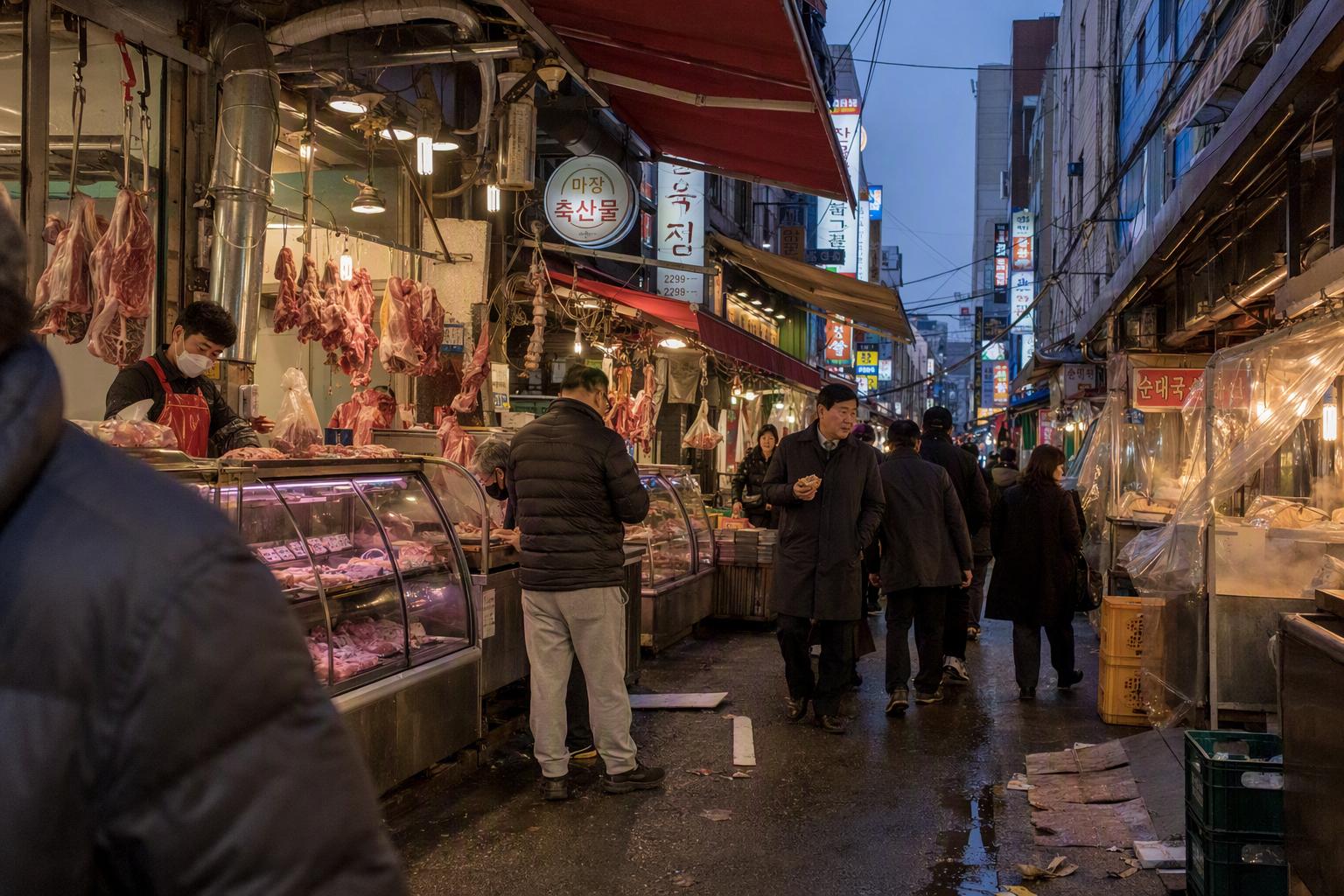
Majang Meat Market, in Seongdong-gu, is the place most travelers mean when they search for a Seoul meat market. It is widely described as Korea’s largest livestock market, with thousands of shops and a strong reputation for Hanwoo, Korea’s prized native beef. Official tourism information lists the market around 03:00–23:00, with closures on the first and third Sunday of each month, but individual shops and restaurants can vary. Check the latest hours before making the trip, especially around public holidays.
This is not a polished restaurant district where you sit down, order a set menu, and let the evening unfold quietly. Majang is more tactile than that. You choose meat from a butcher, usually priced by weight, then take it to a nearby grill restaurant where you pay a separate table-setting fee to cook and eat it with side dishes.

What makes Majang different from a regular KBBQ restaurant
At a normal Korean BBQ restaurant, the restaurant controls the meat selection, the side dishes, and the final bill. At Majang, the experience is split in two.
You buy your beef from a butcher first. Then you move to a nearby dining space that provides the grill, table setup, and banchan. Reported table-setting fees are usually around ₩5,000–₩6,000 per adult, though this can change by restaurant. In Korean, this fee is often called 상차림비, or sangcharim-bi.
That separation is the whole appeal. You get more control over the cut, grade, and amount of meat, and the total can be much better value than ordering comparable Hanwoo at a high-end KBBQ restaurant. Korea Tourism Organization information describes prices here as up to around 30% lower than large supermarket chains, but market prices move, so use posted prices rather than old blog numbers as your final guide.
Who Majang is best for
Majang works beautifully for travelers who are genuinely interested in beef, Korean food culture, and a market meal with a little happy chaos around the edges. It is especially rewarding if someone in your group enjoys comparing cuts and marbling rather than simply ordering a familiar galbi set.
It is less ideal for a group that wants a seamless dinner with English-friendly service, a vegetarian-heavy table, or a romantic atmosphere without decision-making. The charm is real, but it is still a working meat market. Give it a little patience and it gives a lot back.
Hanwoo at Majang: grades, prices, and what to watch
Korean beef quality grades are usually shown as 1++, 1+, 1, 2, and 3, with 1++ at the top. Some shops or online posts may casually use terms like 1+++, but that is not the standard official grading language. If you see wording that feels unclear, ask the shop to point out the actual grade, origin, and price per 100g.

A practical meal budget depends on how premium you go. Some traveler-facing guides suggest around ₩30,000–₩60,000 per person for a Hanwoo-focused meal, not including every possible extra. Past market price snapshots have shown premium 1++ cuts around ₩12,000–₩18,000 per 100g, with examples such as flower ribeye, chuck flap tail, and outside skirt sitting at different price points. Treat these as orientation, not a guarantee. Current retail prices can be higher, and the exact cut matters a lot.
| Term you may see | What it helps you understand |
|---|---|
| 한우 | Korean native beef, usually the reason people come to Majang |
| 1++ | Top standard Korean beef quality grade |
| 원산지 | Country or place of origin |
| 100g | Common pricing unit for meat counters |
| 상차림비 | Table-setting fee at the grill restaurant |
| 육회 | Korean raw beef dish, often made with very fresh beef |
A few Majang mistakes that are easy to avoid
- Forgetting the closure pattern. The first and third Sunday closures are easy to miss, and holidays may affect hours too.
- Comparing it to a sleek restaurant. Majang is a market meal first. If you want a smooth course dinner, choose a restaurant instead.
- Buying only by grade. 1++ tells you quality, but cut, fat level, and your own taste matter just as much.
- Ignoring the table-setting fee. It is not a scam; it is part of the market dining structure.
- Counting on freebies. Some shops may offer small service items like extra beef for soup or raw beef, but it is not something to demand or assume.
- Getting dazzled by unfamiliar grade language. Stick with the standard 1++ to 3 scale and clear price labels.
A more polished Hanwoo splurge near Majang: Born & Bred
For travelers who want the Majang neighborhood but not the full market negotiation, Born & Bred is the famous upscale reference point nearby. It is connected to a family with deep roots in the meat trade and has grown into a multi-level Hanwoo dining destination at 1 Majang-ro 42-gil.
A 2024 visitor report described a casual dining course at ₩165,000 per person, including raw beef, several Hanwoo cuts, a beef hot pot rice dish, noodles, and dessert. Menus and prices can change, so check current booking details directly before building an evening around it.

The trade-off is clear. Majang gives you market energy and flexible spending. Born & Bred gives you curation, comfort, and a premium dinner mood. Both make sense; they just answer different travel cravings.
Garak Market: Seoul’s giant food engine
If Majang is the answer for meat, Garak Market is the answer for scale. Officially known as Garak Agricultural and Marine Products Wholesale Market, it opened in 1985 in Songpa-gu and covers a huge area with separate zones for produce, seafood, and livestock. The livestock section was added in 1986.
Garak is the sort of place that reminds you Seoul does not eat by magic. Vegetables, fruit, seafood, and meat move through this market in enormous volume. It is more about food distribution than a neat tourist stroll, but for travelers who love markets, cooking, or restaurant supply culture, it has its own pull.

Hours vary by section. Produce and seafood markets are generally closed on Sundays, New Year’s Day, Seollal, and Chuseok, while the livestock section also closes on public holidays. Third-party guides describe very early seafood auction activity around 02:00–05:00, livestock market activity around 04:00–22:00, and livestock auctions around 10:30 and 14:30, but these details are the kind to verify before setting an alarm.
Majang or Garak?
| Choose this | When it fits your trip |
|---|---|
| Majang Meat Market | You want Hanwoo, butcher counters, and a market-style BBQ meal |
| Garak Market | You want a large wholesale food market with produce, seafood, and meat infrastructure |
| Born & Bred | You want premium Hanwoo without managing the market process yourself |
| Neighborhood butcher shop | You are staying longer and cooking, rather than sightseeing |
For most short-term visitors, Majang is the easier food memory to build a half-day around. Garak is more interesting for market lovers, early risers, seafood fans, or travelers staying around Jamsil and Songpa.
For cooking in Seoul: look for city-certified butcher shops
Not every meat-focused traveler wants a market. Some are staying in serviced apartments, visiting family, or shopping for a barbecue at home. In that case, Seoul’s 우리동네 모범정육점 program is worth knowing.
This city certification highlights neighborhood butcher shops that meet hygiene and management standards. Shops must meet conditions such as domestic beef and pork sales ratios, lack of recent administrative penalties, on-site inspection scores, smart temperature management, annual rechecks, and proper hygiene practices. Certified shops are listed through Seoul food safety information channels, including map search services.

It is not as atmospheric as Majang, but it is practical. For longer stays, this may be the most useful way to find a trustworthy local butcher near your accommodation.
The similarly named US places people mix into the search
A small detour, because this is where the search results get messy.

Seoul Food Meat Company in Charlotte
Seoul Food Meat Company is a Korean-Southern BBQ fusion restaurant and bar in Charlotte, North Carolina, not a butcher shop or Korean market. It has two known locations: South End at 1400 S Church St, Ste A and Mill District at 421 E 26th St. Expect wings, BBQ trays, drinks, patios, karaoke rooms, and a social dining mood. Hours and phone numbers vary by listing, so use the current official website or map profile before going.
Seoul Meat Co. in Kirkland
Seoul Meat Co. is an all-you-can-eat Korean BBQ restaurant at The Village at Totem Lake, 12600 120th Ave NE, Suite 146, Kirkland, Washington. The shopping center directory lists it as open daily 12:00–22:00, first-come first-served, with no reservations. Reports mention strong demand, possible long waits at peak dinner times, and recent all-you-can-eat pricing often around $48–$55, depending on tier. Prices, time limits, and premium cut rules have shifted in listings and reviews, so check directly.
Seoul Market in California
Seoul Market in La Cañada Flintridge, California, is a Korean and international grocery store at 2383 Foothill Blvd Ste A1. It is known for Korean groceries, prepared foods, kimchi, kimbap, ramen, frozen foods, drinks, and Korean BBQ meats for cooking at home. Listings commonly show daily hours around 08:00–21:00. Reviews often describe it as convenient and well stocked, though sometimes pricier than larger Korean grocery clusters.
Seoul Meat in Honolulu
Seoul Meat in Honolulu is listed as a meat products and wholesale business at 1095 Dillingham Blvd, not a restaurant. Suite numbers differ across listings, so calling ahead is smarter than relying on one directory page.
A Houston note
Some searches also pull in Houston’s Korean community around Spring Branch, including long-running Korean restaurants such as Seoul Garden and Korea Garden. That is a separate Texas Korean food scene, not part of Seoul’s market culture in Korea.
So, which one belongs on your Korea itinerary?
For a Seoul trip, the clean edit is this:
- Go to Majang Meat Market if you want the classic Seoul meat market experience and a Hanwoo BBQ meal built around your own butcher-counter choices.
- Go to Garak Market if you are more curious about Seoul’s wholesale food system, produce, seafood, and early-market rhythm.
- Book a premium Hanwoo restaurant such as Born & Bred if you want the Majang connection with more polish and less decision-making.
- Use certified neighborhood butcher shops if you are cooking in Seoul and care more about reliability than sightseeing.
- Ignore Seoul Food Meat Company, Seoul Meat Co., Seoul Market, and Honolulu’s Seoul Meat for Korea travel planning unless you are also traveling in the United States.
Names can be slippery, especially when Seoul becomes a brand word around the world. Once the name fog clears, the Seoul choice is actually quite satisfying: Majang for beef, Garak for food-market scale, and a good butcher shop when you want dinner to happen in your own kitchen.