
Mosu Seoul and the 2026 Michelin Dining Scene: A Traveler’s Guide
The reopened Mosu is a Michelin two-star restaurant in Yongsan/Itaewon, with a San Francisco backstory, a fiercely competitive reservation book, and a place among Seoul’s most talked-about fine dining tables.

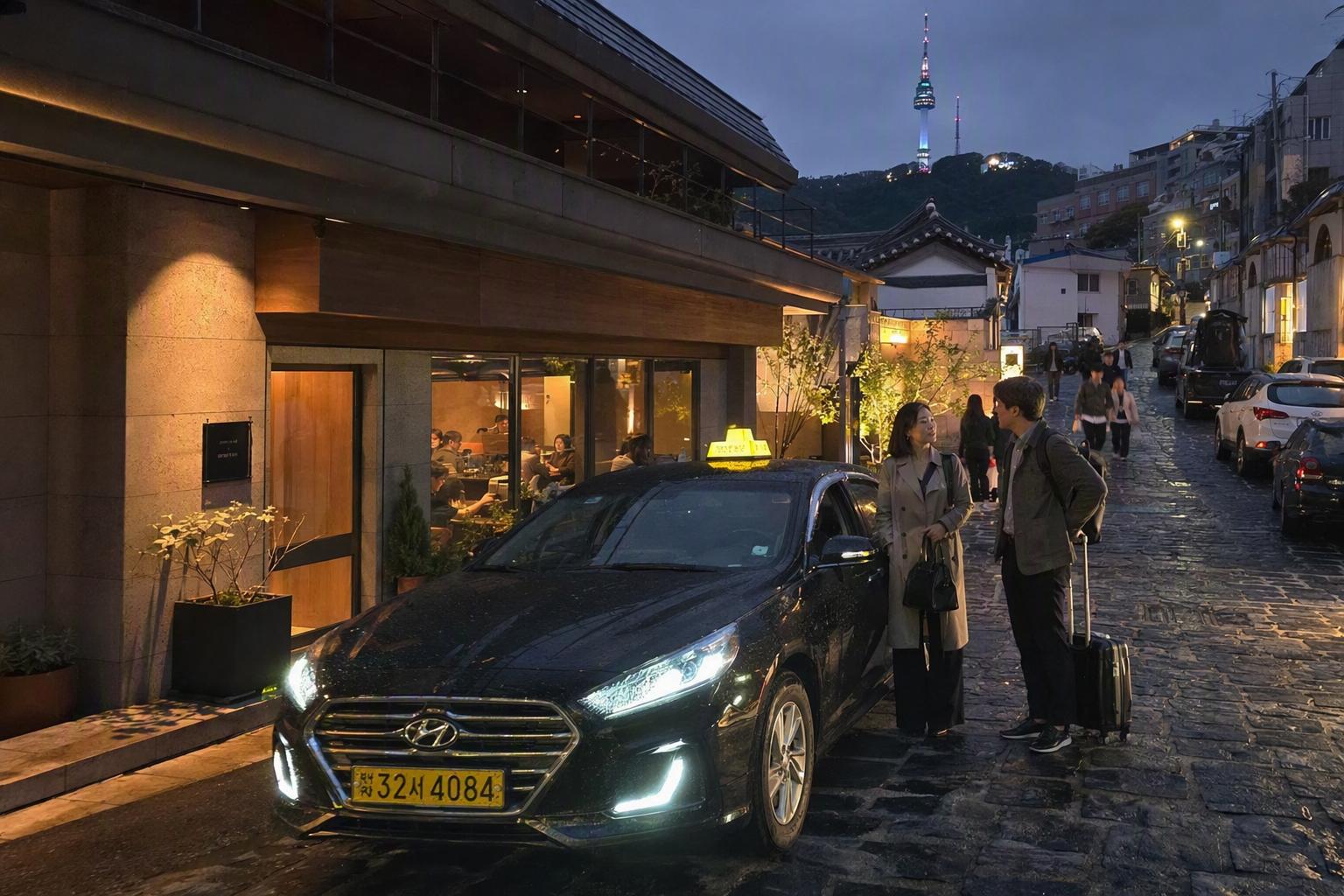
Mosu Seoul is one of those restaurant names that seems to travel faster than the restaurant itself. Some travelers know it from its former three-star moment. Others know Chef Sung Anh from the wider Korean fine dining conversation. A few still remember that Mosu was born in San Francisco before it became one of Seoul’s most watched tables.
For 2026, the cleanest way to describe Mosu is this: Mosu Seoul is a Michelin two-star modern cuisine restaurant in Yongsan/Itaewon, reopened after a major reset, and still one of Korea’s most difficult reservations. It is no longer listed as a three-star restaurant in the current Michelin Guide, even though that older label still floats around online.
That small correction changes how to plan your meal. Mosu is still a serious destination restaurant, but it sits in a different position now: not the single highest-rated Michelin table in Korea, but a high-profile comeback with a very particular point of view.
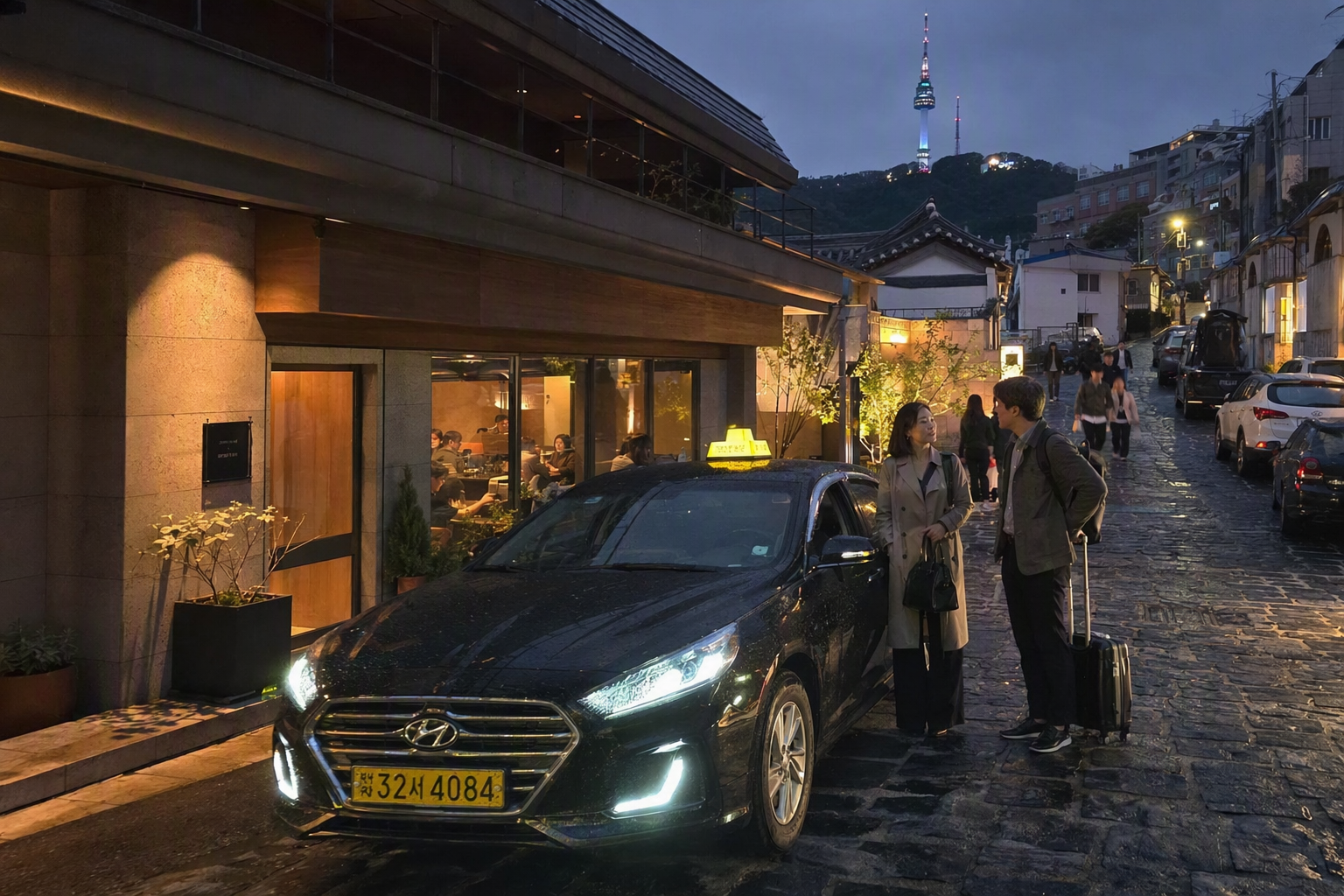
Mosu Seoul in 2026: the accurate version
The current Michelin Guide lists Mosu Seoul as a two-star restaurant. It was previously Korea’s only three-star restaurant in the 2023 and 2024 guides, which is why older articles, social posts, and travel summaries can be confusing. For a trip in 2026, use the current two-star listing as the reliable reference point.
This is not really a fall-from-grace story. Mosu closed, reorganized, moved into a new phase, and returned to the guide after reopening. In restaurant terms, that is a major creative and operational reset. Michelin’s current language around Mosu focuses on precision, balance, imagination, Korean seasonal ingredients, layered textures, and clarity rather than maximum luxury for its own sake.
Essential details for travelers
| Detail | Current information to use for planning |
|---|---|
| Restaurant | Mosu Seoul |
| Chef | Sung Anh / Anh Sung-jae |
| 2026 Michelin status | Two stars |
| Cuisine | Modern cuisine |
| Price category | ₩₩₩₩ |
| Address | 4 Hoenamu-ro 41-gil, Yongsan-gu, Seoul, 04344 |
| Hours listed by Michelin | Tuesday–Saturday, 18:00–22:00 |
| Closed | Sunday–Monday |
| Phone | +82 2-6272-5678 |
| Reservation note | Michelin indicates restaurant-managed reservations; many local sources point travelers to CatchTable or CatchTable Global |
A very practical note: ignore old Mosu addresses unless the restaurant itself confirms otherwise. Older listings may still show former Itaewon or Hannam-area details. For 2026, the address to use is 4 Hoenamu-ro 41-gil, Yongsan-gu.
As always with fine dining in Seoul, hours, prices, corkage, and booking policies can change faster than English-language pages are updated. Before locking in taxis, hotels, or special-occasion plans, confirm the latest details through Mosu’s official channel, CatchTable, CatchTable Global, or the restaurant directly.
Why Mosu still feels bigger than a normal restaurant booking
Mosu has a unusually compact but dramatic history. Before Seoul, before the three-star headline, and before the reopening, there was Mosu San Francisco.
Chef Sung Anh opened Mosu in San Francisco’s Fillmore district as an intimate tasting-menu restaurant with around 18 seats. Early reports described it as a high-end, reservation-only experience shaped by French technique, Korean memory, Japanese discipline, Chinese influence, and California ingredients. The price was ambitious for the time, with reports around USD 195 for a long tasting menu, and the restaurant earned a Michelin star during its short San Francisco run.

Chef Anh’s background helps explain the restaurant’s style. Before Mosu, his résumé included kitchens such as Urasawa in Beverly Hills, The French Laundry in Yountville, Benu in San Francisco, and Aziza. That mix of Japanese luxury, French structure, contemporary American polish, and Korean identity became part of Mosu’s DNA.
Mosu San Francisco closed in April 2017, and Chef Anh relocated the project to Seoul. From there, the restaurant climbed quickly: one Michelin star in 2020, two stars in 2021, then three stars in the 2023 and 2024 guides. For a short period, Mosu Seoul was the only three-star restaurant in Korea.
Then came the reset. After the end of its partnership with CJ CheilJedang, Mosu closed and reorganized. The restaurant reopened in March 2025 in its current Yongsan/Itaewon location, near the Namsan and Grand Hyatt Seoul side of the neighborhood. In the 2026 Michelin Guide Seoul & Busan, Mosu returned as a two-star restaurant.
For travelers, that history matters because the meal is not just about tasting expensive ingredients. Mosu is one of the clearest examples of modern Korean fine dining as a global story: California beginnings, Korean relocation, Michelin peak, closure, rebuild, and comeback.
The current Mosu menu: controlled, seasonal, and not overly loud
Mosu’s current format is widely reported as a dinner-only tasting menu, with the core menu price often cited around ₩420,000 per person. Treat that as a planning estimate, not a permanent promise. Fine dining prices in Seoul can shift, and add-ons, pairings, tax/service details, and cancellation policies may vary by booking channel.
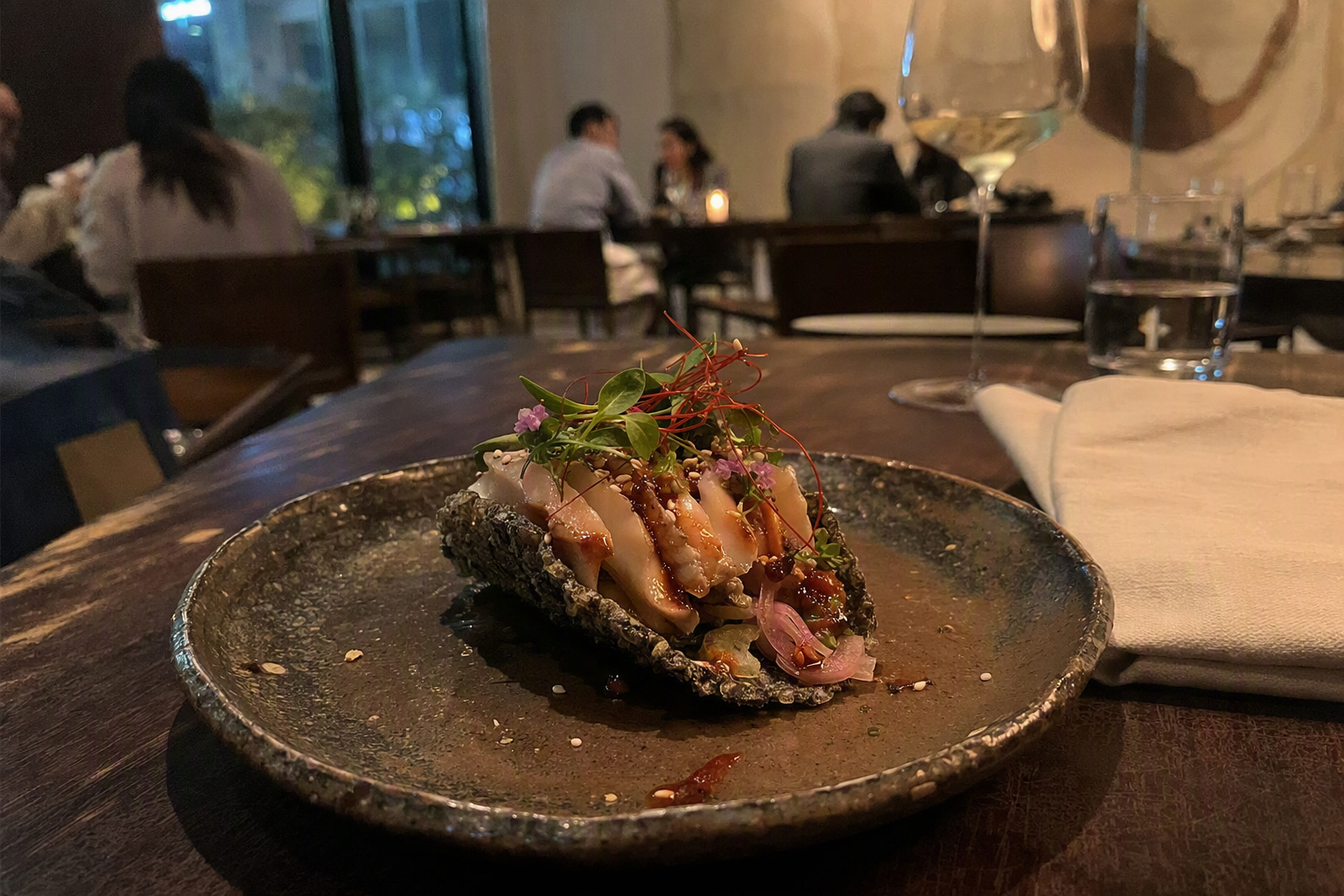
The dishes most often associated with the reopened Mosu include:
- Abalone taco
- Sesame tofu
- Burdock tart or burdock tarte tatin
- Sourdough
- Seasonal fish courses
- Tilefish steamed in anchovy broth
- Seasonal luxury supplements such as truffle or caviar, when offered
Menus at this level move with the season, so do not treat any dish as guaranteed. The more useful expectation is the style: Korean ingredients, careful reduction, clean lines, precise textures, and a quieter kind of confidence. Michelin’s recent comments point toward restraint and clarity rather than a parade of rich sauces and luxury toppings.
That makes Mosu a good fit for diners who enjoy controlled, architectural tasting menus. If your dream Seoul meal is overflowing, warm, generous Korean comfort food, Mosu may be fascinating but not emotionally direct in the same way. If you like watching how a chef turns Korean references into something spare and exact, it becomes much more compelling.
What the bill can look like
A Mosu dinner is a splurge even before wine.
| Item | Planning estimate |
|---|---|
| Dinner tasting menu for one | Around ₩420,000 |
| Dinner tasting menu for two | Around ₩840,000 |
| Reported corkage | Often cited around ₩200,000 per bottle |
| Wine pairing or drinks | Variable, can significantly raise the total |
| Seasonal supplements | Variable, only if offered |
For two people, it is realistic to think of Mosu as a ₩840,000+ evening before drinks, and easily above ₩1.1 million to ₩1.5 million if pairing, corkage, supplements, or premium bottles are involved. This is exactly the kind of restaurant where the base menu price is only the start of the math.
Drinks, corkage, and one small caution
Mosu’s corkage is commonly reported at ₩200,000 per bottle, with some sources mentioning a one-bottle limit. The exact rule is worth confirming before bringing anything special. Some reports describe the limit differently, and restaurants can revise corkage policies without much warning.
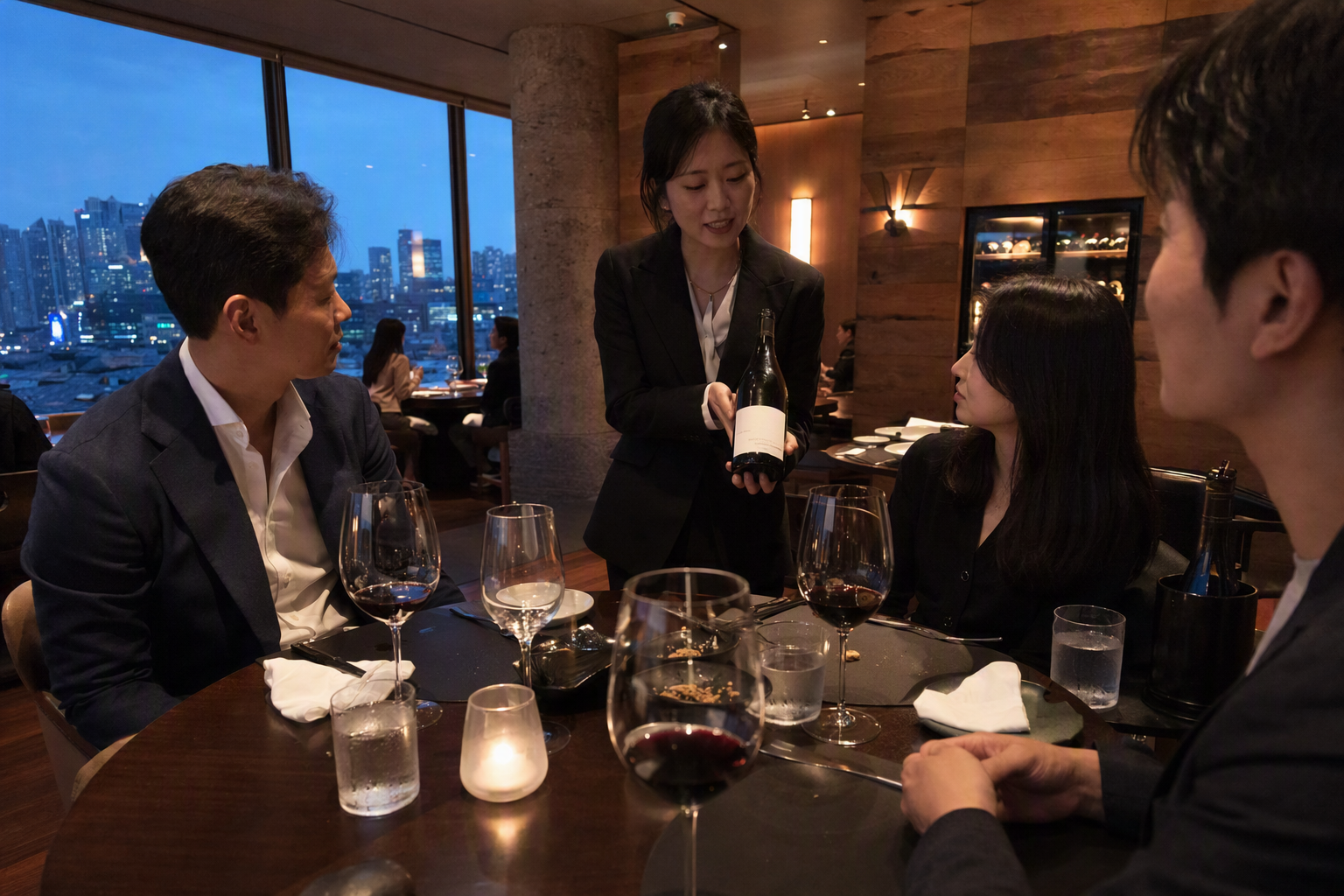
There has also been recent public attention around Mosu’s wine service. In April 2026, reports alleged that a different vintage was served during a wine pairing than the one guests expected, and the restaurant later issued an apology on social media. That does not automatically mean travelers should avoid Mosu, but it does make wine verification a sensible habit, especially for premium pairings.
For high-end dining anywhere, but especially at this price point, it is perfectly reasonable to:
- Ask to see the bottle when a vintage-specific wine is served
- Take a quick photo of labels for your own reference
- Ask whether the pairing list is fixed or subject to substitution
- Confirm corkage terms in writing if bringing your own bottle
- Check whether a premium pairing includes specific vintages or examples
Handled politely, this is not awkward. It is part of protecting a very expensive meal.
Reservations: Mosu is more like ticketing than casual dining
Mosu’s reservation pressure is intense. Around the reopening period, Korean media reported that three months of dinner reservations opened on CatchTable and sold out within a day. Vacancy alerts reportedly had thousands of people waiting, and resale offers appeared online at extremely inflated prices.

For international visitors, CatchTable Global is often the friendliest route because it offers an English interface, supports sign-up without a Korean phone number or alien registration card, and can accept overseas Visa or Mastercard deposit payments for participating restaurants. The catch is that inventory may be narrower than what appears on the domestic Korean app.
A realistic booking approach looks like this:
- Create and verify your CatchTable Global account before reservations open
- Add your payment card in advance if the platform allows it
- Check Mosu’s official channel and CatchTable for the current release schedule
- Be online right before the booking drop, not five minutes after
- Use vacancy alerts, but do not rely on them as your only plan
- Watch for cancellations 48–72 hours before your target date
- Avoid buying resold reservations unless the restaurant explicitly allows transfers
Some Korean sources have mentioned monthly reservation openings around the 15th at 10:00 KST, but release patterns can change. Old screenshots are not a booking strategy. The only schedule that matters is the one active for your dining month.
Hotel concierge teams can sometimes help, especially at luxury properties, but even they may not be able to override a full book. For a trip built around Mosu, it is smarter to have a second fine-dining choice ready rather than letting one missed drop reshape your whole Seoul itinerary.
Seating: counter energy or private calm
The new Mosu space has been described as a more deliberate, multi-level dining room. If you enjoy watching a serious kitchen work, the first-floor counter is the seat to request when available. It gives the meal more movement and a closer look at pacing, plating, and service rhythm.
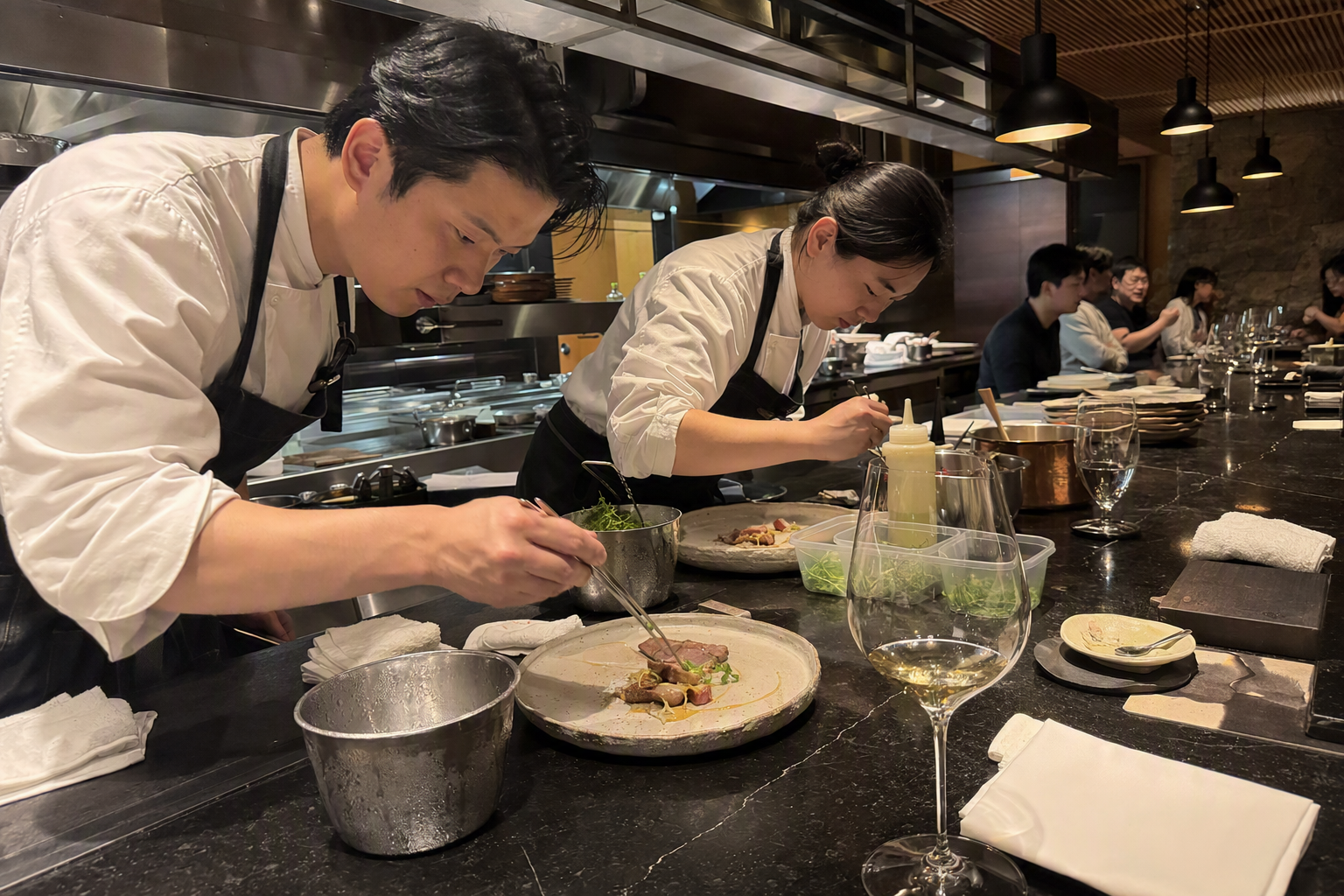
For anniversaries, business dinners, or guests who prefer conversation over kitchen immersion, an upper-floor or private-room setting may be more comfortable. Private rooms, age policies, dress code, valet parking, and special seating requests are exactly the details to confirm at booking. Public information on these policies can be inconsistent.
Mosu is listed for dinner service from 18:00 to 22:00, so plan the evening with breathing room. The Yongsan/Itaewon location near Namsan is lovely, but this is not the dinner to squeeze between a late museum visit and a tightly timed show. Arrive calm. A tasting menu at this level works better when nobody is watching the clock.
Where Mosu fits in Seoul’s 2026 Michelin scene
The 2026 Michelin Guide Seoul & Busan selected 233 restaurants in total, with 46 starred restaurants nationwide. Seoul remains the center of Korea’s Michelin fine dining map, with 42 starred restaurants: one three-star, ten two-star, and thirty-one one-star restaurants. Busan has four one-star restaurants in the same guide.
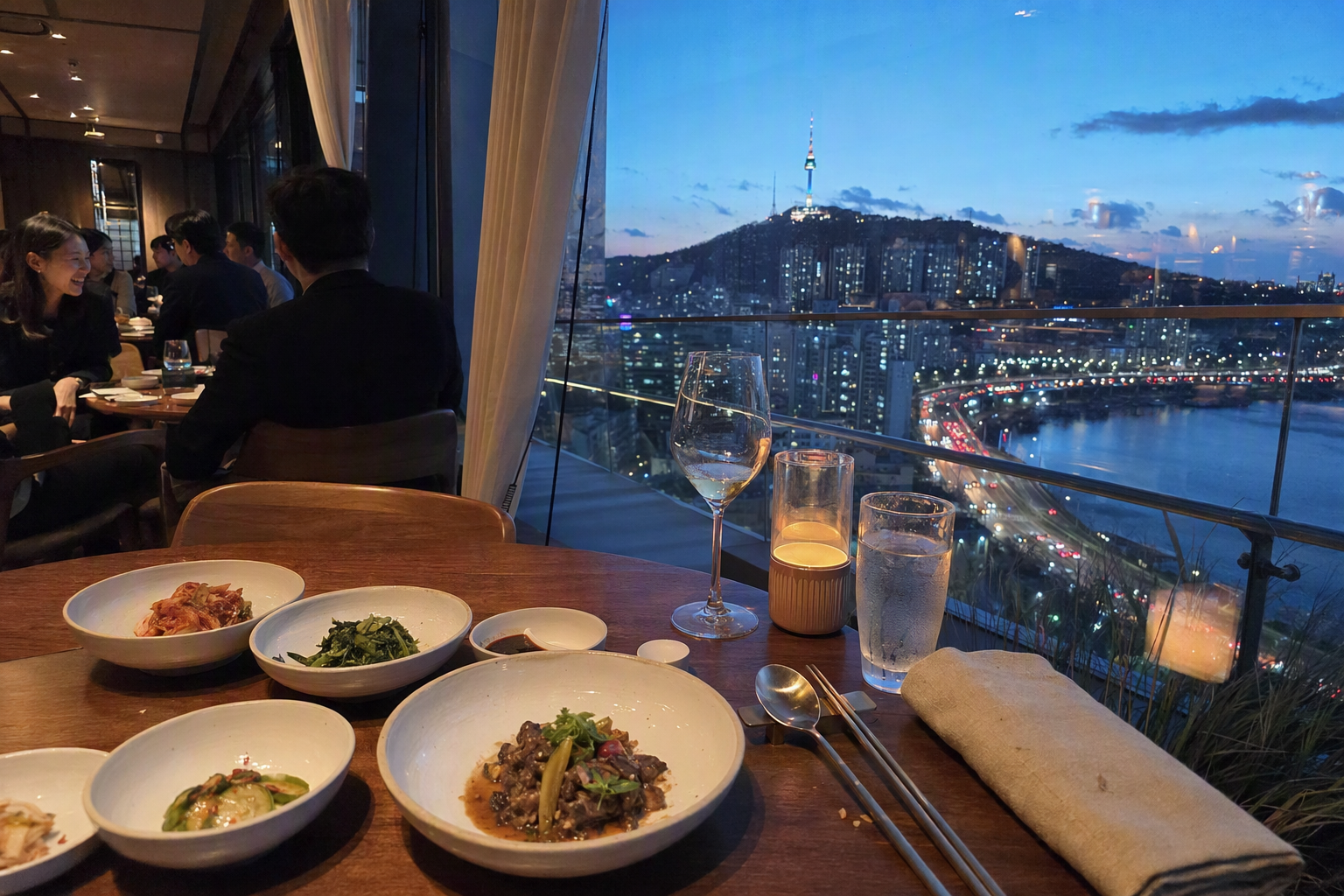
The important headline for travelers: Mingles is Korea’s only Michelin three-star restaurant in 2026. It kept that status for a second consecutive year. So if your goal is simply to eat at the highest-rated Michelin restaurant in Korea right now, Mingles is the clearer answer.
Mosu now belongs to Seoul’s two-star tier, alongside restaurants such as La Yeon, Evett, Kwon Sook Soo, Soigné, Jungsik, Alla Prima, Mitou, and Restaurant Allen. That two-star group is where Seoul becomes especially interesting: traditional Korean luxury, contemporary Korean tasting menus, experimental international cooking, and chef-driven counter restaurants all sit close together, but the experiences can feel very different.
Mosu vs Mingles: which one fits your trip better?
Both are major Seoul reservations, but they scratch different itches.
| Choose Mosu if... | Choose Mingles if... |
|---|---|
| You are interested in Chef Sung Anh’s San Francisco-to-Seoul story | You want Korea’s current Michelin three-star restaurant |
| You like precise, restrained, modern Korean-influenced tasting menus | You want a polished modern Korean meal with the strongest current Michelin status |
| You are curious about a major reopening and creative reset | You prefer a restaurant with recent continuity at the top rating |
| You want dishes associated with Mosu, such as abalone taco, sesame tofu, burdock tart, and tilefish in anchovy broth | You want a restaurant known for Korean fermentation, seasonal ingredients, and a globally recognized modern Korean identity |
| You are comfortable with a dinner-only, high-demand reservation chase | You can plan well ahead, often several weeks in advance |
At Creatrip, we would not frame this as which restaurant is better in the abstract. The better question is what kind of Seoul fine dining memory you want to take home. Mingles is the cleaner choice for travelers collecting the current top Michelin rating. Mosu is the more layered choice for travelers drawn to restaurants with a story, a reset, and a sharper sense of creative tension.
Other Seoul fine dining choices worth considering
Mosu and Mingles get the headlines, but Seoul’s fine dining scene is much broader than one impossible booking.

Jungsik is a strong option for travelers who want contemporary Korean references in a polished Gangnam setting. Michelin descriptions connect its cooking to ideas like kimbap, bibimbap, and banchan reinterpreted through a modern tasting menu lens. It is also one of the names often tagged as more solo-diner friendly.
Soigné is another two-star choice that can appeal to solo diners and guests who enjoy chef-led seasonal storytelling. Its menu is known for the idea of changing episodes, with a minimalist, kitchen-centered feel.
Kwon Sook Soo leans into refined Korean dining with a more traditional luxury mood, and it operates lunch and dinner on listed service days. For travelers who want Korean identity to feel more direct and rooted, it can be easier to understand emotionally than a more abstract tasting counter.
La Yeon is another classic luxury name in Seoul, especially for travelers who want a formal Korean fine dining atmosphere. Depending on the season and booking channel, lunch can make restaurants like this more practical than dinner-only destinations.
Evett, Alla Prima, Mitou, and Restaurant Allen sit in Seoul’s two-star conversation with their own angles, from more experimental Korean ingredient work to refined international cooking. They may not have Mosu’s global backstory, but they can be a better fit if your dates, budget, or seating needs are less flexible.
Common Mosu planning mistakes
A Mosu reservation is expensive enough that the small mistakes matter. These are the ones worth avoiding.
Mistake 1: Calling it a current three-star restaurant
Mosu was a three-star restaurant in the 2023 and 2024 guides. In the 2026 guide, it is listed as two-star. For bragging rights, expectations, and comparison shopping, that distinction matters.
Mistake 2: Using an old address
Use 4 Hoenamu-ro 41-gil, Yongsan-gu. If a map listing sends you somewhere else, cross-check before getting in the taxi.
Mistake 3: Budgeting only for the tasting menu
The reported ₩420,000 menu price is already high, but wine, pairings, corkage, supplements, and cancellation penalties can change the real cost of the evening. A couple can easily move well beyond ₩1 million.
Mistake 4: Waiting until arriving in Seoul to book
For Mosu, booking after landing is usually too late unless you get lucky with cancellations. Treat it like a high-demand concert ticket.
Mistake 5: Buying a reservation from a stranger
Resold reservations can come with scam risk, transfer issues, or cancellation by the restaurant. Unless Mosu clearly allows the transfer, it is not worth building a special night around an unofficial purchase.
Mistake 6: Not checking policy details
Age restrictions, dress code, allergies, valet parking, corkage limits, private room fees, and cancellation charges should be confirmed through the booking channel. Public information is not always consistent.
How to shape the rest of your evening
Mosu’s current home is in the Yongsan/Itaewon area near Namsan, which gives the meal a quieter Seoul feeling than the brighter shopping districts. It pairs naturally with a slower afternoon: Hannam-dong galleries or cafes, a relaxed hotel break, then dinner by taxi. Afterward, Itaewon and Hannam are close enough for a drink if the tasting menu does not completely end the night for you.
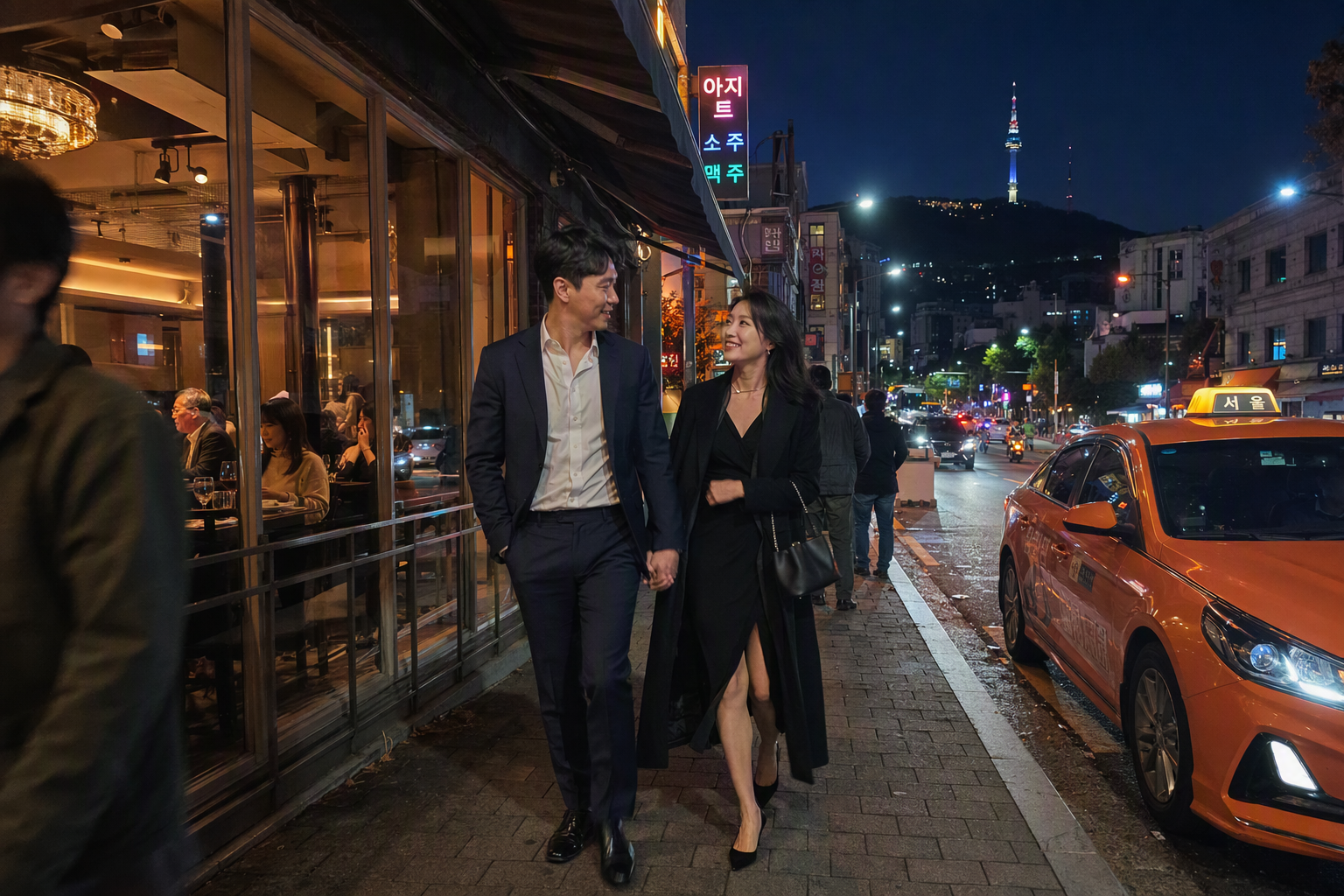
We would avoid stacking Mosu after a packed palace day, a tight K-pop event schedule, or a late intercity train arrival. Fine dining fatigue is real. The meal is expensive, long, and detailed; it deserves an evening that is not already exhausted.
For seasons, spring and autumn are especially appealing for high-end dining in Korea. Restaurants working with local produce, seafood, mountain vegetables, mushrooms, and fermented flavors tend to have a naturally expressive pantry in those months. That said, Mosu is seasonal by design, so winter and summer will have their own logic.
Creatrip’s take on Mosu Seoul
Mosu Seoul is not the simple answer to the question, where is Korea’s top Michelin restaurant? In 2026, that answer is Mingles. Mosu is also not the easiest fine-dining plan in Seoul, nor the most budget-friendly way to experience Korean cuisine.
But Mosu is still one of Korea’s most meaningful restaurants. Its journey from an 18-seat San Francisco tasting room to a Michelin-starred Seoul institution, then through closure, relocation, and a two-star return, gives it a rare narrative weight. The current menu seems to be moving with restraint: Korean ingredients, clean structure, controlled textures, and recognizable signatures like abalone taco, sesame tofu, burdock tart, sourdough, and tilefish in anchovy broth.
Book Mosu if the story matters to you, if you enjoy quiet precision, and if you are willing to work for the reservation. Book Mingles if the current three-star status is the priority. Keep Jungsik, Soigné, Kwon Sook Soo, La Yeon, and other two-star restaurants close as strong alternatives.
Seoul is at its best when you do not treat one restaurant as the whole scene. Mosu is a fascinating chapter, not the entire book — and for the right traveler, that chapter is still very much worth reading with a fork in hand.